


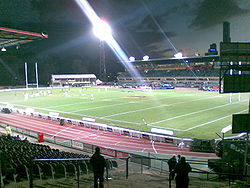
Le Olympic Park Stadium est un stade ouvert situé à Melbourne en Australie, consacré à la pratique du rugby à XIII, du rugby à XV, du football et de l’athlétisme. Inauguré en 1986, il peut accueillir 18 500 spectateurs dont 11 000 places assises. Il est le terrain du Melbourne Storm qui joue en National Rugby League (NRL), de 1998 à 2000 et de 2002 à 2009, et des Melbourne Rebels qui jouent en Super15 en 2007.
Location
0 m
Olympic Park Stadium was a multi-purpose outdoor stadium located on Olympic Boulevard in inner Melbourne, Australia. The stadium was built as an athletics training venue for the 1956 Olympics, a short distance from the Melbourne Cricket Ground, which served as the Olympic Stadium. Over the years it was the home of rugby league side, Melbourne Storm and the A-League team, Melbourne Victory; throughout its life the stadium played host to athletics. Olympic Park Stadium was located in Olympic Park, which is part of the Melbourne Sports and Entertainment Precinct.
Olympic Park Stadium was demolished in 2012, and replaced with an Australian rules football ground. This new ground, Olympic Park Oval, has been used by the Collingwood Football Club for training purposes, it being adjacent to the Melbourne Sports and Entertainment Centre.

0 m
The Motordrome, also known as the Olympic Park Speedway, the Melbourne Speedway or the Victorian Speedway, was an Australian rules football ground and speedway located approximately on the site of the present day Melbourne Rectangular Stadium in Olympic Park in Melbourne, Victoria. The ground was primarily a speedway track, but also hosted football matches.

24 m
Olympic Park Oval is an Australian rules football venue located on the site of the former Olympic Park Stadium in Olympic Park, Melbourne. The oval is primarily utilised as the training ground of the Collingwood Football Club and as a venue for some of the club's Victorian Football League matches. It is located alongside the club's other tenanted facility, the Melbourne Sports and Entertainment Centre.

24 m
1987 World Masters Athletics Championships is the seventh in a series of World Masters Athletics Outdoor Championships that took place in Melbourne, Australia, from 28 November to 6 December 1987. The 4,000+ participating athletes made this the largest track and field meet in the world.
The main venue was Olympic Park Stadium, which had hosted the 1956 Summer Olympics. A World Games Promotional Track and Field Meet was held at Olympic Park Stadium on 7 December, 1986 as a warm-up publicity showcase.
The stadium was later demolished in 2011 and replaced by Olympic Park Oval. Throwing events were held in Gosch's Paddock next to the tracks.
Cross Country was held at Royal Park. The marathon course included Port Melbourne, South Melbourne, St Kilda and Elwood, with start and finish at Olympic Park Stadium.
The three-time Olympian Raelene Boyle carried a friendship torch into the stadium to light an Olympic-style flame during opening ceremonies on Sunday, 29 November.
This edition of masters athletics Championships had a minimum age limit of 35 years for women and 40 years for men.
The governing body of this series is World Association of Veteran Athletes. WAVA was formed during meeting at the inaugural edition of this series at Toronto in 1975, then officially founded during the second edition in 1977, then renamed as World Masters Athletics at the Brisbane Championships in 2001.
This Championships was organized by WAVA in coordination with a Local Organising Committee of Peg Smith, Ray Callaghan.
In addition to a full range of track and field events,
non-stadia events included 10K Cross Country, 10K Race Walk, 20K Race Walk, and Marathon.
After an experimental suspension of the relays in 1983
and forming regional relay teams in 1985,
relays reverted to national teams for this Championships.

31 m
The Burnley Tunnel is a tollway tunnel in Melbourne, in Victoria, Australia, which carries traffic eastbound from the West Gate Freeway to the Monash Freeway. It is part of the CityLink Tollway operated by Transurban. Running under the Yarra River and the inner suburbs of Richmond and Burnley, the tunnel provides a bypass of the central business district.