

 English
 Français
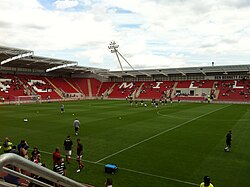
New York Stadium
Le New York Stadium est un stade de football anglais situé à Rotherham dans le Yorkshire du Sud. C'est le stade du club de troisième division Rotherham United.
Nearby Places View Menu

117 m
New York Stadium
The New York Stadium, currently known as the AESSEAL New York Stadium for sponsorship reasons, is a football stadium in Rotherham, South Yorkshire, England. Opened in July 2012, it is the home ground of Rotherham United Football Club, with a capacity of 12,021.
Historically the land that the stadium is situated on was called New York and is referenced in many maps up to around the 1980s, although it is said that the name is inspired by the Guest and Chrimes company which previously occupied the site for nearly 150 years. Guest and Chrimes manufactured a brass stop tap that was and still is in use in many fire hydrants worldwide, many hydrant covers have the foundry's name on them along with the towns name, the stop taps are also said to be used in the famous red fire hydrants of New York City.
Known colloquially as the NYS, it hosted several matches during the UEFA Women's Euro 2022.

386 m
Rotherham (UK Parliament constituency)
Rotherham is a constituency represented in the House of Commons of the UK Parliament since 2012 by Sarah Champion of the Labour Party.

386 m
Rotherham Westgate railway station
Rotherham Westgate railway station was the eastern terminus of the five-mile-long Sheffield and Rotherham Railway, the first passenger-carrying railway in the Sheffield/Rotherham area. In central Rotherham on the eastern bank of the River Don, it was a single-platform terminus that opened on 31 October 1838 and closed on 4 October 1952.

455 m
St Bede's Church, Rotherham
St Bede's Church is a Roman Catholic parish church in Rotherham, South Yorkshire, England. The Gothic Revival style church, designed by Weightman and Hadfield, is situated on the corner of Station Road and St Bede's Road in Masbrough near the town centre. Built from 1841 to 1842, it was opened eight years before the Restoration of the English hierarchy in 1850.
464 m
Masbrough Independent Chapel
The Masbrough Independent Chapel (also known as Masbro Independent Chapel, Masbrough Chapel and Masbro Chapel) was an Independent or Congregationalist chapel in the Masbrough district of Rotherham, from the 18th century until the 1970s, at which point it became part of the United Reformed Church.
The chapel remained part of the United Reformed Church until its closure as a place of worship towards the end of the 20th century.
The chapel's congregation merged with the Greasbrough congregation of the United Reformed Church and then, in 2003, with the Greasbrough Methodist congregation to form a local ecumenical partnership using the name Greasbrough United Church.
The former chapel building was Listed as a building of special historical or architectural interest. After it was no longer used as a place of worship, it found a new use as a carpet warehouse.
The building suffered two serious fires in 2012, and it was demolished in December 2012.
The chapel was closely associated with the Walker family who were leading industrialists in Rotherham. The Walker Mausoleum stands in the chapel's burial ground and the Mausoleum is itself a Listed building.
The chapel was also closely associated with the Rotherham Independent Academy, a training school for ministers, founded in 1795. Later in the 19th century, the Academy moved from Masbrough to new premises built in "collegiate gothic" style on Moorgate Road, Rotherham.
The Moorgate Road premises are now occupied by the Thomas Rotherham College.
In 1795, Dr Edward Williams took the pastorate at the chapel and also became the first theological tutor at the then newly formed Rotherham Independent Academy which was built nearby. Joshua and Thomas Walker were generous benefactors to the Academy.
Williams had been one of those involved in the formation in 1794 of the missionary society that was later named London Missionary Society. Williams preached the charge to the first missionaries sent out by the society.
During the ministry of the Reverend Thomas Nicholson (served 1879–1900) the worshipping congregation grew from 225 to 530.
During the Depression of the 1920s and 30s, the congregation organized the construction of a bowling green on land near the chapel by un-employed men, for their recreational enjoyment, and classes in boot repair and other things were held to help them through the Depression.
During the 1950s, the chapel's minister Cyril Grant provided ministerial oversight for the formation and development of a new church at Herringthorpe, the church that is now the Herringthorpe United Reformed Church. This work first started in hired rooms at the Herringthorpe Junior School, later moving into its own purpose-built premises on Wickersley Road, adjacent to the Stag Inn.