


Boag's Brewery (J. Boag & Son) is an Australian brewery company founded in 1883 by James Boag and his son, also named James, in Launceston, Tasmania, Australia. It is now owned by Lion, a Trans-Tasman subsidiary company of Japanese beverage conglomerate, Kirin. All of the company's beers are produced in Launceston.
Gallery


Sponsored
Location
1 explorer visited this place
221 m
Paterson Barracks is an Australian Army barracks in Launceston, Tasmania. It was named after William Paterson, an officer in the New South Wales Corps. The barracks is the home of the 16th Field Battery, which is the oldest artillery unit in Australia. Paterson was also home to a depot of 10 Health company, part of the 2nd Force Support Battalion, which has its HQ at Derwent Barracks, Glenorchy and also is the home for Army and Australian Air Force Cadets in the Launceston Area.
In 2017 it was announced by Marise Payne, the Minister of Defence that Patterson Barracks will no longer be used by Defence and all units currently using the site will be moved to Youngtown Barracks.

237 m
The Victoria Bridge in Launceston, Tasmania, Australia carries Tamar Street across the North Esk River.
Also known as the Tamar Street Bridge, the original 500 feet timber bridge opened on 10 January 1899. With the ironwork and bridge piling deteriorating, it closed on 27 September 1965. A replacement concrete bridge was built by the Public Works Department, opening on 31 July 1966.
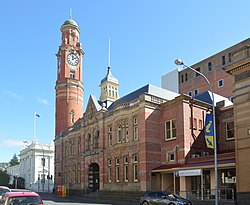
291 m
Launceston Post Office is a heritage-listed post office at 68-72 Cameron Street, Launceston, Tasmania, Australia. It was designed by William Waters Eldridge, with alterations prior to opening designed by Corrie and North. It opened in 1891, while the clock tower was completed in 1903 and altered in 1910. It was added to the Australian Commonwealth Heritage List on 22 June 2004.

313 m
The Albert Hall is a convention centre in Launceston, Tasmania in the style of high Victorian architecture, first opened as the main structure for the Tasmanian Industrial exhibition which ran from 25 November 1891 to 22 March 1892. It is located on the corner of Tamar Street and Cimitiere Street. It was first listed on the Register of the National Estate on 21 March 1978.
Designed by John Duncan and built by J.T. Farmilo at a cost of 14,000 pounds, it features a large two-level brick-and-stucco hall, containing a historically significant water-powered organ manufactured by the English firm of Charles Brindley c. 1859. The organ was made from blackwood and pine, and its bellows are uniquely lined with kangaroo skin.

316 m
The Launceston Gasworks is a former industrial site located in the CBD of Launceston, Tasmania. The site was the principal supplier of gas to the City of Launceston before the importation of LPG in the 1970s. The gasworks produced gas by heating coal and siphoning off the gas that it released before refining and storing it on site in a set of 3, steel frame gasometers. The first buildings on site were the horizontal retort buildings built in 1860 from sandstone and local brick. The site was later used by Origin Energy as their Launceston LPG outlet. The site is instantly recognizable by its 1930s, steel braced, vertical retort building with the words "COOK WITH GAS" in the brickwork.