

 English
 Français

Paradise Square
Paradise Square is a Georgian square in the City of Sheffield, England. Located to the northwest of Sheffield Cathedral, the square is set on a slope and was formerly used for public meetings.
Nearby Places View Menu

117 m
Sheffield Cathedral
The Cathedral Church of St Peter and St Paul, Sheffield, also known as Sheffield Cathedral, is the cathedral church for the Church of England diocese of Sheffield, England. Originally a parish church, it was elevated to cathedral status when the diocese was created in 1914. Sheffield Cathedral is one of five Grade I listed buildings in the city, along with the Town Hall, Abbeydale Industrial Hamlet, and the parish churches at Ecclesfield and Bradfield.
The cathedral is located on Church Street in the city centre, close to the head of Fargate. Construction of the earliest section of the cathedral dates back to c. 1200, with the newest construction completed in 1966; the building is an unusual mixture of medieval and modern architecture. Cathedral tram stop, located outside the front churchyard, opened in 1994 and is today served by all four lines of the Sheffield Supertram network. Most recently, the cathedral underwent an interior and exterior refurbishment in 2013–2014.
Sheffield Cathedral was damaged in a fire on 14 May 2020, an investigation into which is ongoing; a 40-year-old woman has been arrested and charged with arson. The fire destroyed a portion of the cathedral used by a homelessness charity. A previous fire caused damage to the cathedral belltower in 1979.

153 m
Old Bank House
Old Bank House is the oldest surviving brick-built house in Sheffield City Centre in South Yorkshire, England. It lies on Hartshead, north of the High Street.
Although the Manor Lodge had been partly constructed from brick, the first brick building in Sheffield city centre was not completed until 1696, and was initially much ridiculed. However, by the 1720s, several houses had been rebuilt in brick, and Burrowlee House in Hillsborough had been completed, so the style was no longer a novelty.
The building was constructed in 1728 by the Quaker merchant Nicholas Broadbent. From 1771 until 1782, his grandson Thomas Broadbent ran a bank from the building, having moved to Page Hall.
The three-storey building is divided into five bays, with the central bay brought slightly forward. The central bay and corners of the building are marked with giant pilasters, and a plain pediment tops the facade. St Peter's Close runs through the ground floor of the leftmost bay.
The interior of the building, restored in the 1970s and further improved in 2006 contains some original panelling and plasterwork and is partially Grade I listed. The building is Grade II* listed and is now used as offices by Bank House Chambers, the longest established set of barristers chambers on the North Eastern Circuit, who began operating in 1862.

159 m
Church Street, Sheffield
Church Street is in the centre of Sheffield, South Yorkshire, England, at grid reference SK353874. It runs for approximately 490 yards (450 m) in a westerly direction from its junction with Fargate and High Street to its termination at the crossroads formed by the junction with West Street, Leopold Street and Townhead Street. Church Street has its own Sheffield Supertram stop directly in front of the Sheffield Cathedral and it carries that name.
159 m
Pennine Five
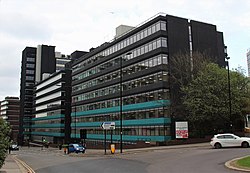
Pennine Five (P5), known as the Pennine Centre prior to 2020, is a tower on Tenter Street in Sheffield, England. Construction started in 1973 on this immense building and was completed in 1975.
The tower is 50 m (164 ft) tall and has 13 floors of office space. It was built in the International style, like the Arts Tower in Sheffield and Tower 42 in London.
The Pennine Centre was built for HSBC and used as their regional headquarters. HSBC moved to a new-build regional headquarters at Charter Square on the other side of the city centre in 2019. The unoccupied building was subsequently purchased by RBH Properties for £18 million, who then carried out a £30 million refurbishment of the complex, rebranding it as Pennine Five or P5. The first phase of the refurbished project, codenamed Block Three, reopened for commercial use in June 2020.