


Harrison is a Roanoke, Virginia neighborhood located in central Roanoke, that initially developed in the 1920s as an early Roanoke suburb. It borders the neighborhoods of Melrose-Rugby and Washington Park on the north, Gilmer on the south, Gainsboro on the east and Loudon-Melrose on the west. Its northern boundary is concurrent with U.S.
Location
1 explorer visited this place

385 m
Harrison School is a historic public school building for African-American students in Roanoke, Virginia. It is a rectangular, 13-bay brick building done in modified Georgian Revival architecture. The school was built in 1916, and two-story wings were added in 1922. It was the first school in the city to educate black students beyond the seventh-grade level, and its first principal was the noted educator Lucy Addison. After closing as a school in the 1960s, the building served as a child care center and later low-income housing as well as the home of the Harrison Museum of African American Culture.
It was listed on the National Register of Historic Places in 1982.

445 m
Lucy Addison High School was an all-African American high school founded in 1928 during Jim Crow racial segregation in Roanoke, Virginia.
Named after Lucy Addison, a pioneering African American educator and first principal of the segregated Harrison School, Lucy Addison High School became Roanoke's second all-African American secondary educational institution. During its history, the school operated in two separate buildings: at Roanoke's Douglas and Hart Avenues between 1928 and 1952; and at Roanoke's Fifth Street and Orange Avenue between 1953 and 1970.
As a result of Roanoke's desegregation of its high schools in 1963, Addison eventually became an integrated high school in 1970. Though the City of Roanoke closed Addison's doors as a high school in 1973, Addison was converted into Lucy Addison Junior High School. The building now operates as Lucy Addison Junior High School within the Roanoke City Public School System.

602 m
Melrose–Rugby Historic District is a national historic district located in the Melrose–Rugby neighborhood of Roanoke, Virginia. It encompasses 111 contributing buildings and 2 contributing objects in a planned residential subdivision, with most of the dwellings being built between the late 1910s and late 1940s. It is a primarily residential district with single-family dwellings. The houses include American Craftsman-style bungalow, American Foursquare, and Cape Cod style.
It was listed on the National Register of Historic Places in 2013.
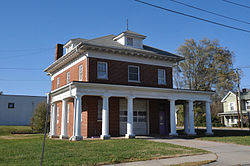
719 m
Fire Station No. 5 in Roanoke, Virginia is a former fire station at 216 12th Street NW, in the independent city of Roanoke. The neighborhood fire station was one of three built in 1911, and was designed to look like a house, blending into its residential neighborhood. It housed one of the city's first fire trucks to be powered by an internal combustion engine. It served the city as a fire station until 2010, when it was turned over to a local nonprofit organization.
The building was listed on the National Register of Historic Places in 2011 as City of Roanoke Fire Station No. 5.
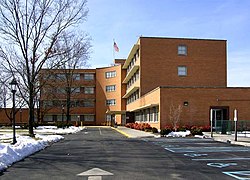
841 m
Burrell Memorial Hospital, currently operating as Blue Ridge Behavioral Health Burrell Center, was an historic African-American hospital originally located in the Gainsboro neighborhood of Roanoke, Virginia. The hospital replaced the 1914 Medley Hospital. It opened March 18, 1915 as a 10-bed facility in a converted home at 311 Henry Street. In 1921 the hospital moved to a new, 55-bed location in the adjacent Harrison Neighborhood, having renovated the former Allegheny Institute at 611 McDowell Ave., NW. The final facility was constructed 1954-55 on the same property as a four-story, 73,000 square foot, International Style building. It is T-shaped with three wings extending from a central elevator core. The building housed the only African-American medical facility in Roanoke from 1915 to 1965. It was listed on the National Register of Historic Places in 2003. Burrell Memorial Hospital closed in 1979 due to financial strain and reopened the same year as the Burrell Home for Adults, an adult care facility. This facility grew to provide specialized care to residents, but eventually closed as Burrell Nursing Center in 2002.
In the early 20th century, hospitals in the Appalachian region of Virginia were segregated. In Roanoke and southwest Virginia there were no hospitals available to individuals not considered to be white. "[S]everal black physicians in the area, including Dr. Issac David Burrell, were working diligently to establish a hospital for black residents. In the midst of these efforts, Dr. Burrell became seriously ill with gallstones and was forced to travel in a train baggage car to Washington, D.C. for treatment. He died following surgery, and the heart-wrenching circumstances of his death served as a catalyst to ensure that this tragedy would not be repeated for another black person.
On March 18, 1915, Burrell Memorial Hospital, named in honor of Dr. Burrell, opened at 311 Henry Street. It began as a 10-bed facility equipped with $1,000 of borrowed money but went on to become the first African-American hospital to earn full approval of the American Board of Surgeons. Dr. Lylburn C. Downing, who had been the first African-American accepted as a member of the Roanoke Medical Society, became the first superintendent and held that position until 1947. "After Burrell's death, the doctors Downing, Williman and Roberts, joined by John Claytor, Sr., and Jerry Cooper, founded Burrell Memorial with ten beds on North Henry Street in March 1915."
The flu epidemic of 1919 created the need for expanded facilities, so the hospital moved into the abandoned Allegheny Institute building on the corner of McDowell Avenue and Park Street in 1921. This building was used until 1955 when the present hospital was opened.
Burrell Memorial Hospital remained a prominent black institution until the 1965 Civil Rights Act mandated the desegregation of hospital facilities. In 1979, the hospital closed. as of 2023 The Burrell Center is home to Blue Ridge Behavioral Healthcare.
Book your tour near
Harrison, Roanoke, Virginia
Book Now
4.1
in partnership with
GetYourGuide.com
Route 460 (Melrose/Orange Avenue), and as of the 2000 Census Harrison has a population of 1,019 residents with 393 households.