


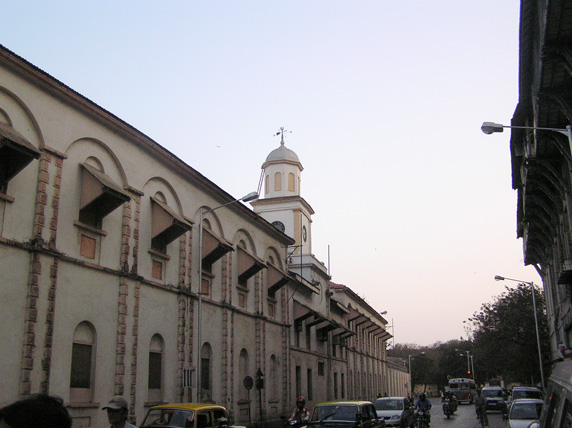
Naval Dockyard, Mumbai, abbreviated as ND (Mbi) and previously known as the Bombay Dockyard, is an Indian shipbuilding yard in Mumbai. The superintendent of the dockyard is a naval officer of the rank Rear Admiral, known as the Admiral Superintendent.
Book your tour near
Naval Dockyard
Book Now
4.5
in partnership with
GetYourGuide.com
Gallery



Sponsored
Location
2 explorers visited this place

289 m
Ballard Pier Mole was a station of the Mumbai Port Trust Railway in the Ballard Pier precinct of South Mumbai, India. The station was the terminating station of the Frontier Mail, and the Punjab Limited Express.

510 m
Bombay Castle is one of the oldest defensive structures built in the city of Mumbai. The current castle is a structure built by the British on the site of the Manor House built by a Portuguese nobleman Garcia de Orta. Orta had leased the island of Bombay from the King of Portugal between 1554 and 1570.
The castle was built of local blue Kurla stone and red laterite stone from the Konkan region to the south. The islands came under the hands of the English in 1665, and the East India Company took possession of the castle in 1668. Over the next ten years, they built a defensive structure around the manor.
The castle had four Bastions, three of which were originally surrounded completely with water. These were named the Flag Staff Bastion, The Flower tree Bastion, and the Tank Bastion. The fourth was the Brab Tree Bastion, known for being near a Brab Tree. This would face the West.
Few records of the original Portuguese castle remain, and historians are trying to piece together the original location of the manor. Two gates of the manor are located within INS Angre, a naval station in South Mumbai. A sundial thought to date back to the Portuguese era is also present. This sundial does not mark out the 12 hours of a day, but rather marks out certain periods that the people of the time deemed important.
The main building within the castle was the Governor's House, in which Gerald Aungier, the second Governor of Bombay used to stay. The Governor's residence was later moved to Parel and then to Malabar Hill over the next two centuries. The current building houses the offices of the Flag Officer Commanding-in-Chief Western Naval Command.
548 m
INS Satavahana is the premier Submarine Training Base of the Indian Navy and is located at Visakhapatnam, Andhra Pradesh. Training is carried out by the Submarine School and the Escape Training School and the School of Advanced Undersea Warfare.

549 m
INS Vajrabahu is an Indian Navy submarine base of the Western Naval Command located near Mumbai in Maharashtra. It was commissioned on 1 February 1996.

710 m
The Reserve Bank of India,, is the central bank of India, regulatory body for the Indian banking system and Indian currency. Owned by the Ministry of Finance, Government of the Republic of India, it is responsible for the control, issue, and supply of the Indian rupee. It also manages the country's main payment systems.
The RBI, along with the Indian Banks' Association, established the National Payments Corporation of India to promote and regulate the payment and settlement systems in India. Bharatiya Reserve Bank Note Mudran is a specialised division of RBI through which it prints and mints Indian currency notes in two of its currency printing presses located in Mysore and Salboni. Deposit Insurance and Credit Guarantee Corporation was established by RBI as one of its specialized division for the purpose of providing insurance of deposits and guaranteeing of credit facilities to all Indian banks.
Until the Monetary Policy Committee was established in 2016, it also had full control over monetary policy in the country. It commenced its operations on 1 April 1935 in accordance with the Reserve Bank of India Act, 1934. The original share capital was divided into shares of 100 each fully paid. The RBI was nationalised on 1 January 1949, almost a year and a half after India's independence.
The overall direction of the RBI lies with the 21-member central board of directors, composed of: the governor; four deputy governors; two finance ministry representatives; ten government-nominated directors; and four directors who represent local boards for Mumbai, Kolkata, Chennai, and Delhi. Each of these local boards consists of five members who represent regional interests and the interests of co-operative and indigenous banks.
It is a member bank of the Asian Clearing Union. The bank is also active in promoting financial inclusion policy and is a leading member of the Alliance for Financial Inclusion. The bank is often referred to by the name "Mint Street".