Location Image

Centrales électriques de Ferrybridge

Les centrales électriques de Ferrybridge étaient une série de trois centrales électriques au charbon situées sur la rivière Aire près de Ferrybridge, dans le Yorkshire de l'Ouest, en Angleterre, en fonctionnement de 1927 à 2016 sur un site à côté du croisement des autoroutes M62 et A1(M). La première station, Ferrybridge A, a été construite au milieu des années 1920 et a fermé ses portes en 1976. Ferrybridge B a été mise en service dans les années 1950 et a fermé dans les années 1990. En 1966, la centrale électrique de Ferrybridge C a été ouverte avec une capacité de production de 2 GW à partir de quatre ensembles de 500 MW ; construite par le Central Electricity Generating Board (CEGB) ; à la privatisation en 1989, la propriété a été transférée à Powergen, puis à Edison Mission Energy (1999), puis à AEP Energy Services (American Electric Power) (2001) et à SSE plc (2004). Ferrybridge C a fermé ses portes en mars 2016. Deux des quatre unités ont été équipées d'une installation de désulfuration des gaz de combustion (FGD) en 2009. En 2013, SSE a indiqué que la centrale électrique ne serait pas conforme à la directive sur les émissions industrielles, exigeant la fermeture de l'installation d'ici 2023 ou plus tôt. Il a ensuite été annoncé que l'usine serait entièrement fermée d'ici mars 2016. Ferrybridge Multifuel 1 est une centrale énergétique de 68 MW fonctionnant à partir de déchets multiples sur le site, qui est devenue opérationnelle en 2015. Ferrybridge Multifuel 2 est une centrale multifuel de 70 MW construite à côté de l'usine MF1, qui est devenue opérationnelle en 2019. Le 28 juillet 2019, l'une des tours de refroidissement de Ferrybridge a été démolie, suivie par quatre autres le 13 octobre. La principale chaufferie, la baie de bunker et deux cheminées ont été démolies le 22 août 2021. Les trois dernières tours de refroidissement ont été démolies le 17 mars 2022.

Nearby Places View Menu
Location Image
0 m

Ferrybridge power stations

The Ferrybridge power stations were three coal-fired power stations on the River Aire near Ferrybridge in West Yorkshire, England, in operation from 1927 to 2016 on a site next to the junction of the M62 and A1(M) motorways. The first station, Ferrybridge A, was constructed in the mid-1920s and closed in 1976. Ferrybridge B was brought into operation in the 1950s and closed in the early 1990s. In 1966, Ferrybridge C power station was opened with a generating capacity of 2000 MW. It had been constructed and was then operated by the Central Electricity Generating Board (CEGB). After privatisation in 1989 ownership was passed to Powergen, then to Edison Mission Energy (1999), then to AEP Energy Services (American Electric Power) (2001) and finally to SSE plc (2004). In 2009 two of the four units were fitted with flue-gas desulphurisation (FGD) plant. In 2013 SSE indicated that the power station would not comply with the Industrial Emissions Directive, requiring the plant's closure by 2023 or earlier. It was later announced that the plant would be fully closed by March 2016. Ferrybridge Multifuel 1 is a 68 MW multi-fuel energy-from-waste plant at the site which became operational in 2015. Ferrybridge Multifuel 2 is a 70 MW multi-fuel plant built alongside the MF1 plant, which became operational in 2019. On 28 July 2019, one of Ferrybridge's cooling towers was demolished, followed by a further four on 13 October. The main boiler house, bunker bay and two chimney stacks were demolished on 22 August 2021. The final three cooling towers were demolished on 17 March 2022.
Location Image
379 m

Ferrybridge

Ferrybridge is a village in West Yorkshire, England. Ferrybridge lies at a historically important crossing of the River Aire which borders the North Yorkshire village of Brotherton. It is linked to other communities by the A1, which follows the route of the Great North Road. The village falls within the Knottingley ward of Wakefield City Council. The origin of the place-name is from Old Norse and means bridge by the ferry. It appears as Ferie in the Domesday Book of 1086 and as Ferybrig in 1198.
569 m

Ferrybridge Henge

Ferrybridge Henge is a Neolithic henge near Ferrybridge, West Yorkshire (grid reference SE47462424). It is close to the A1 and M62 and Ferrybridge power station. Ferrybridge Henge is the furthest south of Yorkshire's henges, and is the only one in West Yorkshire. The site is of national importance and is protected from unauthorised change as a Scheduled Ancient Monument; despite this it is under threat from ploughing.
Location Image
712 m

Battle of Ferrybridge

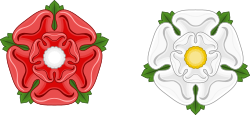
The Battle of Ferrybridge, 28 March 1461, was a preliminary engagement between the houses of York and Lancaster before the larger battle of Towton, during the period now known as the Wars of the Roses.
Location Image
748 m

Ferry Bridge, Brotherton

Ferry Bridge is a historic bridge, connecting Ferrybridge in West Yorkshire with Brotherton in North Yorkshire, in England. There may have been a bridge over the River Aire at this location in the Anglo-Saxon period, which has been supposed to have been destroyed in 1070. The first bridge known definitely to have existed was built in the late 12th century, but it collapsed in 1228, killing a group of Crusaders who were crossing. That year, pontage was granted, a toll for crossing the bridge, to fund repairs. A replacement bridge was built in about 1290, with a bridge chapel completed by 1306. In 1461, during the War of the Roses, the Lancastrian Army partly destroyed the bridge, but the Yorkist Army was still able to cross, on its way to the Battle of Towton. The bridge was restored, and it was described by John Leland in 1538 as being built of stone and having seven or eight arches. Four small arches at its north end took the road across swampy ground. This route became part of the Great North Road in the early Georgian period, with coaching inns established on each riverbank. The bridge was Grade I listed in 1967. The bridge was damaged by storms in 1795, and in 1797 John Carr of York designed a replacement, on a new alignment. Bernard Hartley constructed the bridge, which was completed in 1804. It is carried by eight round-headed arches: three to cross the river, four over land on the Ferrybridge side, and one over land on the Brotherton side. The piers have cutwaters and the bridge has a parapet, with refuges over each pier, and a vase balustrade in the central section.