


Ekiti Sud Ouest
Ekiti Sud Ouest est une zone de gouvernement local de l'État d'Ekiti au Nigeria.
Location
1.6 km
Afe Babalola University Teaching Hospital is a private hospital in Ekiti State, Nigeria. It serves as a training institute for clinical students studying at Afe Babalola University.
2.5 km
Irepodun/Ifelodun is a Local Government Area of Ekiti State, Nigeria. Irepodun/Ifelodun is predominantly a homogeneous society and carefully populated by Yoruba speaking people of the South West of Nigeria. It has an area of 356 km2 and a population of 129,149 at the 2006 census. The major religions of the people are Christianity and Islam while a percentage of the people are traditional religion worshippers.
The thriving industries in the local government include timber and saw mills which include Mighty Sawmill at Igede-Ekiti, Ilamoye Sawmill at Igede-Ekiti, Olorunde Sawmill at Iyin-Ekiti, Igbemo Rice at Igbemo Ekit, ROMACO Company at Igbemo Ekit, Okeorun Sawmill at Orun-Ekiti, Osalade Sawmil at Orun-Ekiti, Oke Uba Sawmill at Awo-Ekiti and Iyedi Sawmill at Igbemo-Ekiti; photo studios; and Hotels, some of which include Corner Stone Hotel, God's Health Hotel, Liberty Hotel and many more.
The places in the Irepodun Local Government that attract tourists from all over are the Osun Tourist Center and Elemi Tourist Center, both located at Igede-Ekiti.
The postal code of the area is 362.
2.5 km
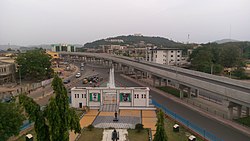
Ado Ekiti is the capital city of Ekiti State, Nigeria. It is the headquarter of the Ekiti central senatorial district, southwest, Nigeria.

5.6 km
Ekiti is a state in southwestern Nigeria, bordered to the North by Kwara State for 61 km, to the Northeast by Kogi State for 92 km, to the South and Southeast by Ondo State, and to the West by Osun State for 84 km. Named for the Ekiti people—the Yoruba subgroup that makes up the majority of the state's population—Ekiti State was carved out from a part of Ondo State in 1996 and has its capital as the city of Ado-Ekiti.
One of the smallest and most educated states with the highest number of professors in Nigeria, Ekiti is the 31st largest in the area and 30th most populous with an estimated population of nearly 3.5 million as of 2022. Geographically, the state is divided between the Nigerian lowland forests in most of the state and the drier Guinean forest–savanna mosaic in the north. Among the state's nature are false acraeas, mona monkey, forest buffalo, and grey parrot populations along with one of the last remaining Nigeria-Cameroon chimpanzee populations with a troop of about 20 chimpanzees in the heavily threatened Ise Forest Reserve. In March 2022, Ekiti State became the first state in Nigeria to adopt a state tree as one of its official symbols. On World Forest Day 2022, Governor Kayode Fayemi announced that Obeche had been chosen as State Tree owing to its local prominence and environmental, economic and cultural significance.
Modern-day Ekiti State has been primarily inhabited for centuries by the Ekiti people, a Yoruba subgroup, with minorities of the Akoko Yoruba subgroup,and Yagba Yoruba subgroup. Religiously, the majority of the state's population are Christian with smaller Muslim and traditionalist minorities at about 5% and 5%, respectively.
In the pre-colonial period, the area that is now Ekiti State was at a time subjugated, like other ethnic groups in the present-day Yorubaland, by the Ibadan impirialist movement which culminated in the collapse of its hegemony in 1890s, and finally, the Ekitiland which formed the Ekiti Confederacy in the latter half of the 1800s. From 1877 to 1893, the Ekiti Confederacy fought the Oyo-Ibadan during EkitiParapo War led by Fabunmi Okemesi-Ekiti alongside other Eastern Yoruba groups and other Western Yoruba groups; the war ended in a British-brokered stalemate before the area was colonized and incorporated into the British Southern Nigeria Protectorate which later merged into British Nigeria in 1914. After independence in 1960, the area of now-Ekiti was a part of the post-independence Western Region until 1967 when the region was split and the area became part of the Western State. In 1976, the Western State was split and the state's east became Ondo State. Twenty years later, Ondo State's northwest was broken off to form Ekiti State.
Economically, Ekiti State is partially based on agriculture, mainly of yams, rice, cocoa, and cassava crops. Key minor industries are logging and tourism. Ekiti has the joint-thirteenth highest Human Development Index in the country and is considered the heart of the homeland of the Ekiti people.
Educationally, Ekiti State has the highest number of professors in Nigeria.

6.0 km
Federal Polytechnic, Ado-Ekiti is a Polytechnic in Ado Ekiti, Ekiti State, Nigeria. The current Rector is Engr. Dr Temitope John Alake. The school is located along Ijan Ekiti road, in Ado-Ekiti, Ekiti State, Nigeria.
Book your tour near
Ekiti Sud Ouest
Book Now
4.1
in partnership with
GetYourGuide.com