


Le cimetière militaire belge de Lierre est un cimetière militaire situé Mechelsesteenweg dans la ville belge de Lierre.
Gallery



Sponsored
Location
1 explorer visited this place

1.6 km
Lier railway station is a railway station in Lier, Antwerp, Belgium. The station opened on 23 April 1855 on railway lines 13 and 15. Until 1988, the station was also on line 205, when this line closed. The train services are operated by the National Railway Company of Belgium.

1.6 km
The Zimmer tower is a tower in Lier, Belgium, also known as the Cornelius tower, that was originally a keep of Lier's 14th-century city fortifications. In 1930, astronomer and clockmaker Louis Zimmer built the Jubilee Clock, which is displayed on the front of the tower, and consists of 12 clocks encircling a central one with 57 dials. These clocks showed time on all continents, phases of the Moon, times of tides and many other periodic phenomena.
In 1980 the tower became a state-protected monument.

1.6 km
Stedelijk Museum Wuyts-Van Campen en Baron Caroly was a fine arts museum located in the city centre of Lier, Belgium. The permanent exhibition offered an overview of mainly Flemish, Belgian and Dutch paintings from the 16th to the 20th century. In addition, the museum holds a collection of objets d'art.
1.6 km
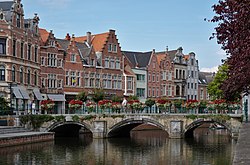
Lier is a municipality located in the Belgian province of Antwerp. It is composed of the city of Lier proper and the village of Koningshooikt. The city centre is surrounded by the river Nete, around which it grew. In 2018, Lier had a total population of 35,712. The total area is 49.70 km2 making a population density of 720 per km2. Lier is known for its beers, its patron saint St. Gummarus and Lierse vlaaikes cake. It is also home to the world headquarters of Van Hool, a global bus and coach manufacturer. Lier's two principal football clubs are K. Lyra-Lierse and K. Lierse S.K.

1.6 km
The siege of Lier of 1582, also known as the capture of Lier or betrayal of Lier, took place between 1 and 2 August 1582 at Lier, near Antwerp, during the Eighty Years' War. On 2 August the Spanish army commanded by Governor-General Don Alexander Farnese, Prince of Parma, supported by part of the States garrison, captured and seized the town, defeating the rest of the Dutch, English and German troops under Governor of Lier. The entire garrison was killed or captured. The news of the Spanish victory at Lier was a shock to the States-General at Antwerp, where the sense of insecurity was obvious, and many of the Protestant citizens sold their houses and fled to northern Flanders.
The consequences of Semple's action were considerable because Liere was a strategic position, regarded as "the bulwark of Antwerp and the key of the Duchy of Brabant". The betrayal of Bruges in the following year by Colonel Boyd was probably prompted by his countryman's example. After a short visit to Prince Alexander Farnese at Namur, Semple was sent to Spain with a strong recommendation to King Philip II of Spain, who according to the Italian Jesuit Famiano Strada, handsomely rewarded him.
The next Spanish success was on 17 November, when the Spaniards led by Johann Baptista von Taxis captured Steenwijk forcing the Protestant troops to surrender.