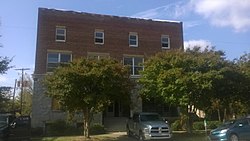
The Champion and Pearson Funeral Home is a historic commercial building at 1325 Park Street in Columbia, South Carolina. Built in 1929, it is an architecturally eclectic landmark in an area that was traditionally a center of African-American economic activity in the city. It was built by the Pearson family to serve as a funeral parlor and residence for the family, during the height of the Jim Crow era.
Location
1 explorer visited this place

31 m
North Carolina Mutual Building, also known as the Blue Palace Tea Shop and Barber Shop, is a historic commercial building located at Columbia, South Carolina, United States. It was built in 1909 by the North Carolina Mutual Life Insurance Company, and is a three-story, rectangular, brick commercial block. The building housed African-American businesses, professionals, and institutions during the years of Jim Crow segregation. It is located in the Washington Street business district, the city's black downtown.
It was added to the National Register of Historic Places in 1995.

172 m
The B.B. Kirkland Seed and Distributing Company is a three-story historic warehouse building at 912 Lady Street in Columbia, South Carolina. It was listed on the National Register of Historic Places in 1979.

179 m
Columbia Electric Street Railway, Light & Power Substation is a historic power substation located at Columbia, South Carolina, USA. It was built in 1900 with later additions and alterations, and is a two-story, Italian Renaissance Revival style red brick building. It features an arcade of rounded compound arches or archivolts. From 1900 until 1936, the building served as a power substation for the Columbia Electric Street Railway, Light & Power Company and its successors.
The Columbia Electric Street Railway, Light & Power Company Substation is architecturally significant for its distinctive Italian Renaissance Revival characteristics and historically significant for its direct association with Columbia's street railway or trolley system. The building was designed by W. B. Smith Whaley, an architect well known for his cotton mills throughout the American southeast. The substation, like many of Whaley's designs, is typically Italian Renaissance Revival in many of its defining features. The primary construction material is monochromatic red brick, laid in common or American bond pattern. The primary architectural element is the arcade of rounded compound arches or archivolts springing from broad piers. The massing is heavy, solid, and imposing. This weightiness is further emphasized by the flat roof and the recessed window and door openings. The substation was renovated in 1912 to meet the growing needs of the burgeoning trolley system - the electrical equipment was upgraded, three bays were added to the west end of the building, a second story was added within the volume of the building, the original office space was removed, and the tile floor was replaced with reinforced concrete throughout the building. A monitor roof was also installed, and the cornice on the west elevation was removed and reused on the extended north elevation. From its construction in 1900 until 1936, when the trolley system permanently discontinued service, the building served as a power substation for the Columbia Electric Street Railway, Light & Power Company and its successors. The trolley system operated by this company and powered by the substation played an integral part in the creation, growth, and subsequent annexation of Columbia's suburbs during the early twentieth century. These developments are illustrative of the broad pattern of trolley-based public transportation and suburban expansion of many American cities in the late nineteenth and early twentieth centuries.
It was added to the National Register of Historic Places in 2011.
187 m
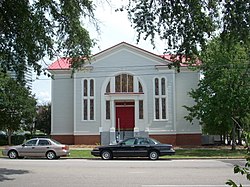
The House of Peace Synagogue is a former synagogue of the Beth Shalom Congregation in Columbia, South Carolina. It was originally located at 1318 Park Street. After the congregation moved in the 1935, the building was used for the Big Apple Club, which was an African-American night club. It was named to the National Register of Historic Places on August 28, 1979. In the early 1980s, the building was moved to its present location at the southeast corner of Hampton and Park Streets. In 1993, it was purchased by the Historic Columbia Foundation and is called the Big Apple.

192 m
Richland Library is the public library system of Richland County, South Carolina. In December 2012, the library shortened its name from Richland County Public Library. It has 11 branches including its 242,000 sq ft Main Library. In 2001, it was named the National Library of the Year by the Library Journal and the Gale Group.
The property was used as a funeral home until 1966. The building was added to the National Register of Historic Places in 2017.
See also
National Register of Historic Places listings in Columbia, South Carolina