


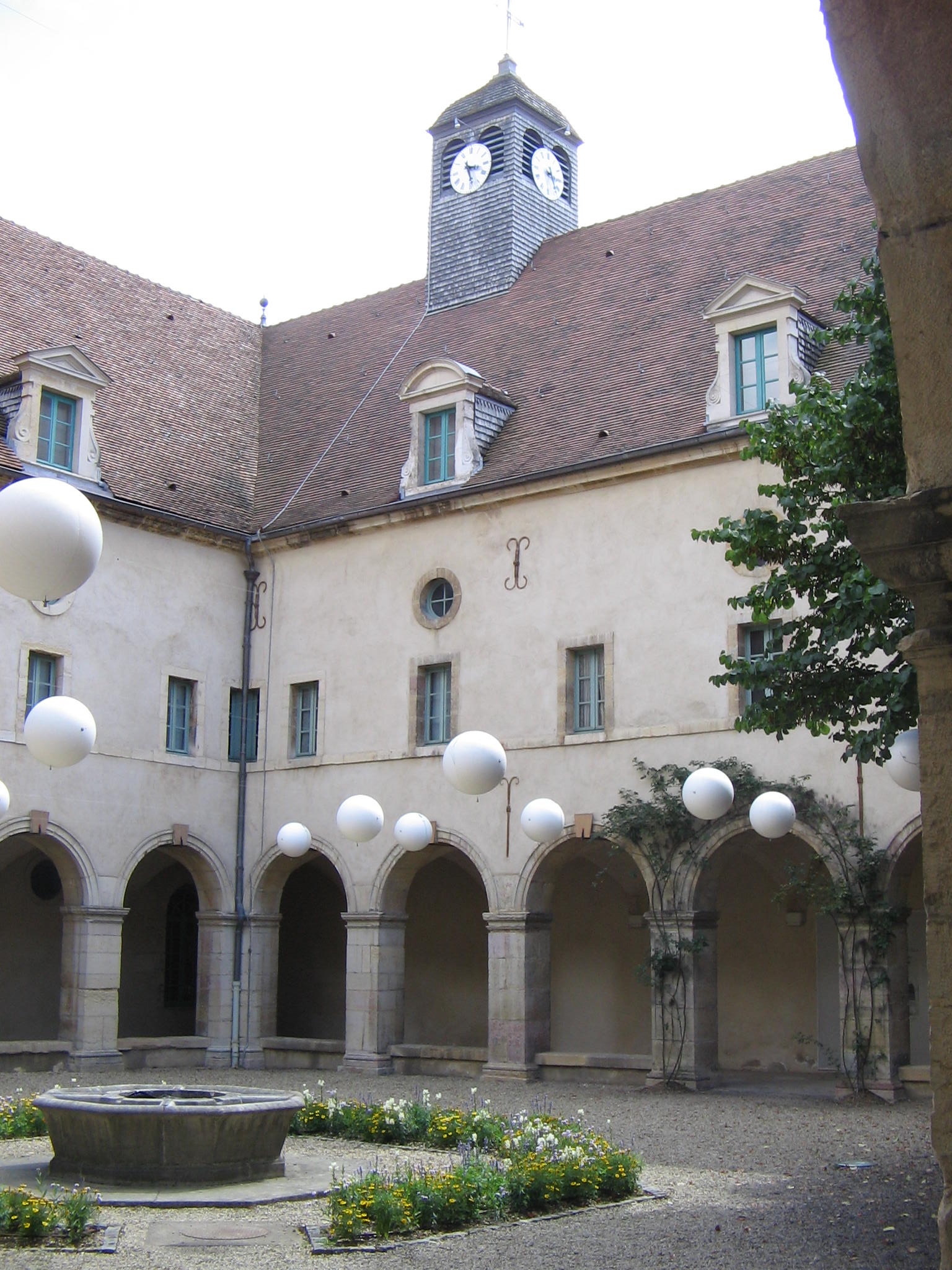
L'hospice Sainte-Anne est un édifice situé dans la ville de Dijon, dans la Côte-d'Or en région Bourgogne-Franche-Comté. Il est fondé en 1633 par Pierre Odebert et son épouse Odette Maillard, dans l'enceinte de l'Hôpital Notre-Dame. En 1803, il s'installe dans l'ancien monastère des Bernardines. L'hospice ferme ses portes en 1974.
Location

62 m
The Musée d'art sacré de Dijon is a municipal museum of Catholic Burgundian sacred art inaugurated in 1980 by Canon Jean Marilier in the Église Sainte-Anne of Dijon. It is labeled "Musée de France" and was associated in 1993 with the Musée de la Vie Bourguignonne Perrin Puycousin located in the nearby monastery. In 1950, the city of Dijon bought the Église Sainte-Anne located at the 17 rue Sainte-Anne to house the museum in 1979. It exhibits sculptures, paintings, furniture, objects of Catholic worship and many relics, which the Church abandoned their use in various religious reforms. In the grandstands there is a large collection of religious clothing, mainly of the 19th and 20th centuries. The museum gathers liturgical objects of the 12th to the 19th century used for Catholic worship, and shows the lives of communities of women belonging to various spiritual families. There are many works by Jean-Baptiste Bouchardon.

312 m
The Archdiocese of Dijon is a Latin diocese of the Catholic Church in France. The archepiscopal see is Dijon Cathedral, which is located in the city of Dijon. The diocese comprises the entire department of Côte-d'Or, in the Region of Bourgogne. Originally established as the Diocese of Dijon in 1731, and suffragan to the Archdiocese of Lyon, the diocese was elevated to the rank of archdiocese in 2002. The most significant jurisdiction change occurred after the Concordat of 1801, when the diocese annexed the department of Haute-Marne. In 1821, a papal bull re-established the Diocese of Langres. Since 2022 the archbishop has been Antoine Hérouard.

341 m
Dijon Métropole is the métropole, an intercommunal structure, centered around the city of Dijon. It is located in the Côte-d'Or department, in the Bourgogne-Franche-Comté region, eastern France. It was created in April 2017, replacing the previous Communauté urbaine du Grand Dijon. Its area is 240.0 km2. Its population was 253,859 in 2018, of which 156,854 in Dijon proper.

351 m
The Battles of Dijon were a series of battles that took place in 1870 and 1871, as part of the Franco-Prussian War, on the current territory of the French commune of Dijon between the French Republic and the German states of Prussia and Baden and later, the German Empire.

412 m
The Académie de Dijon was founded by Hector-Bernard Pouffier, the most senior member of the Parlement de Bourgogne, in 1725. It received royal lettres patentes in 1740. In 1775, it became the "Académie des Sciences, Arts et Belles-Lettres de Dijon." From 1855 to 1869, it was called the "Académie Impériale des Sciences, Arts et Belles-Lettres de Dijon" before returning in 1870 to the name "Académie des Sciences, Arts et Belles-Lettres de Dijon."
In July 1750, it sponsored a prize competition on the question of "whether the reestablishment of the sciences and the arts contributed to purifying morals." Jean-Jacques Rousseau won the prize by arguing in the negative, in his Discourse on the Arts and Sciences. In 1754, he again competed for the prize with his Discourse on the Origin and Basis of Inequality Among Men, but did not win the prize that year.
The Académie des Sciences, Arts et Belles-Lettres de Dijon still exists, and still offers the prize.
Book your tour near
Hospice Sainte-Anne
Book Now
4.3
in partnership with
GetYourGuide.com