


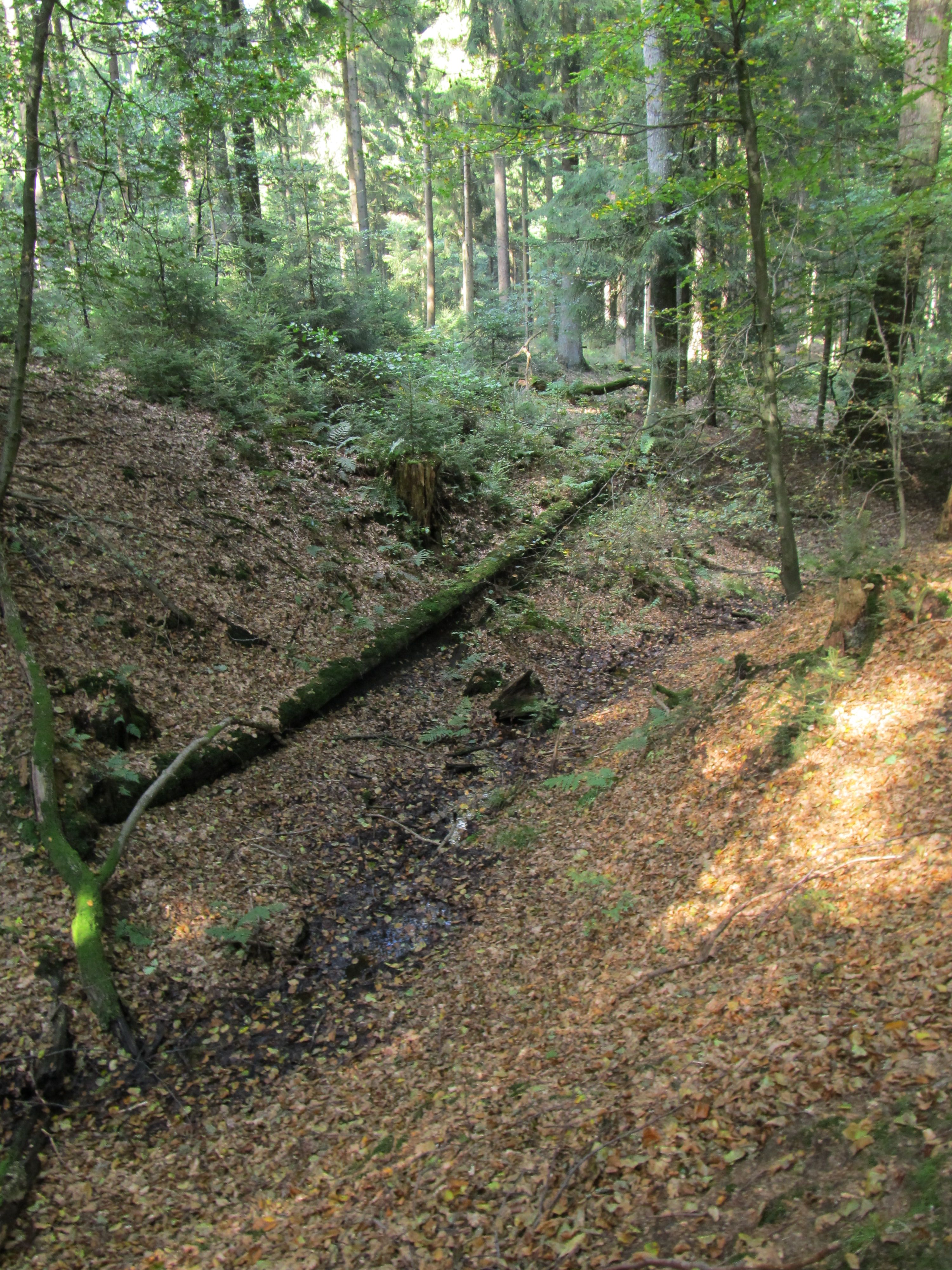
Düte is a river of Lower Saxony, Germany. It flows into the Hase northwest of Osnabrück.
Location
1 explorer visited this place

1.0 km
Halen is a railway station located in Halen, Germany. The station is located on the Oldenburg–Osnabrück railway and the train services are operated by NordWestBahn.

3.1 km
Pye is a district of the city of Osnabrück, Germany. Its positioning in the countryside on the outskirts of Osnabrück and its good transport connections to the city make it an appealing area for residents.
Until 1972 Pye was a separate village in the district of Osnabrück. It belonged to the parish of St. Johann in Osnabrück and was a predominantly Catholic area. Agriculture formed the backbone of the local economy. On 1 July 1972 it became a district of Osnabrück; since 1978 it has had its own parish.
Pye is also the location of the Piesberg). Coal mining took place here during the 19th and 20th centuries. Even today, stones continue to be mined from the Piesberg quarry. The Piesberg was also the location of the largest landfill site in the Osnabrück region until June 2006. The Museum Industriekultur is situated on the Piesberg, giving insight into the history of mining on the mountain.
In Pye there is a street called "Am Pyer Ding". This is in reference to the Old German term "Thing" - meaning that Pye was also the location of such a "Thing".
The countryside surrounding Pye is mostly characterised by small to medium-sized woods, grassland and a branch canal, which is an offshoot of the Mittelland Canal.
The Osnabrück-Piesberg railway station is located at the edge of the district - currently it is only used for special train journeys on event days, travelling there from the central station in Osnabrück via the Osnabrück-Altstadt station.
4.0 km
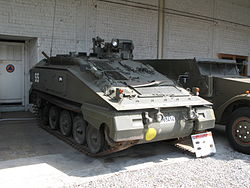
The Osnabrück mortar attack was an improvised mortar attack carried out by a Provisional Irish Republican Army unit based in mainland Europe on 28 June 1996 against the British Army's Quebec Barracks at Osnabrück Garrison near Osnabrück, Germany.

4.5 km
Atter is a district in the west of Osnabrück, Lower Saxony, Germany, with a population of 4,135 residents across 2,030 households. Covering an area of 1,075.9 hectares, it was incorporated into the city of Osnabrück on 1 July 1972. The districts on which it borders are Eversburg, Westerberg, and Hellern. On the west it borders on the municipality of Lotte in North Rhine-Westphalia; Autobahn 1 also passes through this area. The border with Westerberg runs through the Rubbenbruchsee, a local recreation area.
Atter is home to the Attersee, the Protestant Stephanuskirche and Gut Leye which has its own Roman Catholic chapel. The Reformed Protestant Atterkirche was closed down due to financial difficulties. Atter’s cemetery is the smallest in Osnabrück, covering an area of around 10,000 m². Situated in the Leyer Holz north of the district’s centre, it was originally built in 1913.
The former site of the Quebec Barracks covers an area of 370,410 m². Decommissioned in 2008, it used to serve as the headquarters of the British Army in Germany (formerly the British Army of the Rhine. 107 housing units in Atter – mostly built during the 1950s and 1960s – were used by relatives of British soldiers in the area.
4.7 km
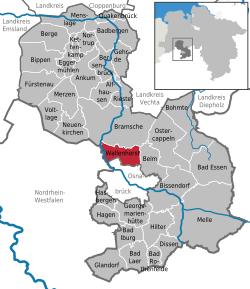
Wallenhorst is a municipality in the district of Osnabrück, in Lower Saxony, Germany. It is situated in the Wiehengebirge, approx. 10 km north of Osnabrück.
The New St. Alexander Church serves as a reference height for all other heights in the German Mean Height Reference System.
See also
List of rivers of Lower Saxony