Location Image

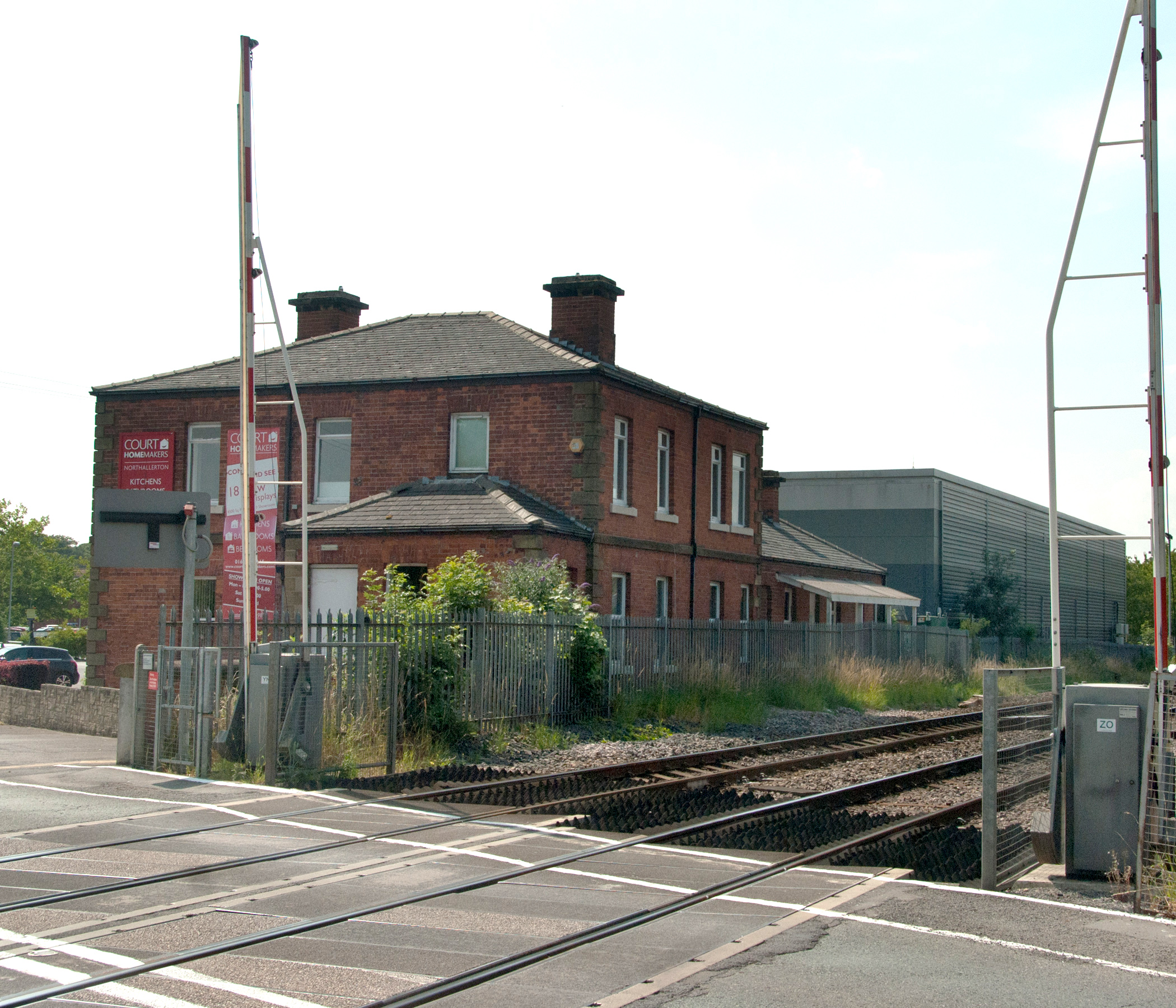
Northallerton Town railway station

Northallerton Town railway station was a railway station on the Leeds Northern Railway just north-east of the present day Northallerton railway station. The station was open for only four years before an amalgamation of railway companies, and the re-routing of the trains through Northallerton station, precipitated its closure.

Nearby Places View Menu
Location Image
429 m

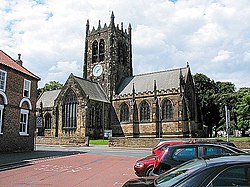
All Saints' Church, Northallerton

All Saints’ Church, Northallerton is a Grade I listed parish church in the Church of England in Northallerton, North Yorkshire.
Location Image
439 m

Porch House, Northallerton

Porch House is a historic building in Northallerton, a town in North Yorkshire, in England. The building was constructed in 1584 for Richard Metcalfe, with an open hall. A wing was added to the rear right in the mid 17th century, then in 1684 a large two-storey porch was added, giving the house its name. In the late 17th century, a floor was inserted in the hall, then in 1781 the building was extensively altered, the work including the addition of a range to the left, and the replacement of the thatched roofs with pantiles. In 1844, the building was further altered, and the porch was demolished and replaced with a single-storey structure. Perhaps at this time, the house was divided into three properties. Railings were installed in front of the house, to protect it during the town's cattle market. Local tradition claims that Charles I of England stayed in the house in 1640 and then was imprisoned there in 1647 before being handed over to Oliver Cromwell. A local legend claims that a secret tunnel connects the house with All Saints' Church, Northallerton, but no tunnel has been discovered. The Metcalfe family later became the Marwood family, and owned the house until 1988. It was marketed for sale in 2009, for £500,000. It has since operated as a guest house. It has been grade II listed since 1969. The house has a timber framed core, it is enclosed in brick, and has a pantile roof. It has two storeys, a range of four bays, and a projecting cross-wing on the left with a hipped roof. In the centre of the main range is a single-storey sandstone porch containing a doorway with an ogee-shaped lintel, and a coped gable with a finial. The windows are a mix of horizontally-sliding sashes and casements. The cross-wing contains a two-storey canted bay window and a doorway to the right. In front of the house are wrought iron railings on a low wall.
Location Image
477 m

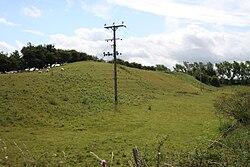
Vale of Mowbray

The Vale of Mowbray is a plain in North Yorkshire, England. It is bounded by the Tees lowlands to the north, the North York Moors and the Hambleton Hills to the east, the Vale of York to the south, and the Yorkshire Dales to the west. Northallerton and Thirsk are the largest settlements within the area. The Vale of Mowbray is distinguishable from the Vale of York by its meandering rivers and more undulating landscape. The vale is the floodplain of the River Swale and its tributaries, including the Wiske and Cod Beck. The river enters the vale from Swaledale, in the north-west, then flows in a south-easterly direction before entering the Vale of York. The underlying geology of the landscape is sandstone and mudstone, with clays and silts in the south-west. The region is agricultural, with a mix of arable and grassland, though isolated pockets of woodland remain. The fields are medium-sized and typically bounded by hawthorn hedges. The villages are often linear, following the major through road, and the houses are generally brick built with pantile roofs. The vale is a major north-south transport corridor, containing the A1 road and the East Coast Main Line, which are respectively the main road and rail links between London and Edinburgh.
Location Image
611 m

Durham House, Northallerton

Durham House is a historic building in Northallerton, a town in North Yorkshire, in England. The building was constructed in 1754 for D. Mitford, to a design by John Carr. In 1860, it was converted into a girls' boarding school. This closed in 1871, and the building was converted into a masonic hall. The former coach house was used by a coachbuilder from 1876, then later as a garage repairing vehicles and selling petrol. By 2011, the house was used for retail. That year, it suffered a serious fire but was later restored. The building has been grade II* listed since 1952. The front of the building is in sandstone, the sides and rear are in brown brick, and it has a sill band, a modillion cornice and a hipped Westmorland slate roof. It has three storeys and five bays. In the centre is a doorway with an architrave, stepped at the base, a swept outer architrave, a tripartite keystone, and a pediment on consoles. This is flanked by plate glass shop windows with cornices on plinths. The upper floors contain sash windows in architraves, those on the middle floor also with pulvinated friezes and cornices. On the left return is a round-arched stair window. The former coach house is built of painted brick, with a floor band, an eaves band, and a pantile roof with coping forming a pediment. There are two storeys and three bays. The ground floor contains casement windows, and on the upper floor is a recessed Diocletian panel flanked by blind oculi. In the centre of the ridge is a wooden louvred vent. It is also by Carr and is grade II listed.