Location Image

Anne Boleyn's Seat

Anne Boleyn's Seat is a historic structure at Studley Royal, a World Heritage Site in North Yorkshire, in England.

The shelter, containing a seat, is at a high point in the garden, known as "Surprise View". The National Trust describes it as "the climax of the garden". The structure was commissioned by William Aislabie and was probably complete by 1790; it was initially described as a "sashed Gothic temple". A headless statue was erected nearby, and it is believed that this led to the structure being named after Anne Boleyn, who was beheaded. The structure provides a view of the ruins of Fountains Abbey, and its name may also reference the role of Henry VIII of England, Boleyn's husband, in the Dissolution of the Monasteries.

The shelter is built of wood. On the west front are three slender Gothick arches on quatrefoil columns, and an elaborate embattled parapet. At the rear is a narrow entrance and a similar parapet, and the side walls are blank. The floor is concrete, and there are two modern benches. It has been grade II listed since 1986.

Nearby Places View Menu
Location Image
526 m

Octagon Tower

The Octagon Tower is a historic structure at Studley Royal, a World Heritage Site in North Yorkshire, in England. The tower was built between 1728 and 1732, probably as a viewing platform. It was commissioned by John Aislabie, and designed by Robert Doe, probably in the neoclassical style. In the 1740s, its appearance was altered to the gothic style, and it may have been at this time that the external steps were added. The building was grade II* listed in 1967, but was ruinous at the time. In 1976, it was restored by North Yorkshire County Council, replacing about 40% of the stonework, all the windows and plaster. It is also a scheduled monument. The tower is built of stone, it has an octagonal plan, and three stages on a deep plinth. The entrance on the east side is approached by eight steps flanked by outward curving walls with pointed coping and piers with ball finials. The doors have a porch with buttresses containing arched niches. In the bottom stage are round-arched sash windows with moulded hood moulds, and the middle stage contains recesses with pointed arches. In the top stage are quatrefoil openings, above which is a parapet and crocketed finials.
Location Image
572 m

Studley Royal Park

Studley Royal Park is an estate in North Yorkshire, England. The site has an area of 800 acres (323 ha) and includes an 18th-century landscaped garden; the ruins of Fountains Abbey; Fountains Hall, a Jacobean mansion; and the Victorian St Mary's church, designed by William Burges. Studley Royal House, around which the park and gardens were designed, burned down in 1946. The park, as Studley Royal Park including the ruins of Fountains Abbey, has been designated a World Heritage Site. It has also been designated a grade I listed park and garden by Historic England, and various structures within it are individually listed. After the Dissolution of the Monasteries, the Fountains estate was owned by the Gresham, Proctor, and Messenger families. At the same time, the adjacent Studley estate was separately held by the Mallorie (or Mallory) and then Aislabie families, after the marriage of Mary Mallory and George Aislabie. The estates were combined on 22 December 1767, when William Aislabie purchased the Fountains estate from John Messenger. In 1966, the property came into public ownership after its purchase by West Riding County Council. In 1983, it was acquired by the National Trust. The gardens and park reflect every stage in the evolution of English garden fashion, from the late 17th century to the 1780s and beyond. Most unusually, both John and William embraced new garden fashions by extending their designed landscape rather than replacing and remaking outmoded parts. As a result, the cumulative whole is a catalogue of significant landscaping styles.
808 m

Poisoning of Abbot Greenwell

Around June 1447, John Greenwell, the abbot of Fountains Abbey, in Yorkshire, Northern England, was poisoned by a monk, William Downom. By the 15th century, Fountains was the richest abbey in England, and its abbot was an important figure in local political society. The first half of the century saw it wracked with internal strife, including a disputed election which had violent repercussions. Greenwell appears to have brought a degree of peace to the abbey upon his election, but he does not seem to have been popular. Downom poisoned a dish of pottage, which he then attempted to feed the abbot while the latter was sick. Greenwell survived, and the case became notorious. Although it took over a year and discussions with Fountains' motherhouse of Cîteaux Abbey, Downom—who may have also had previous offences on his record—was eventually expelled from the abbey. Greenwell himself remained controversial and was both accused and accuser in local lawsuits, and later incurred the distrust of King Edward IV for his political leanings. Greenwell eventually resigned in 1471; Downom remained a monk after being expelled from Fountains and may have joined Kirkstead Abbey in Lincolnshire, following which he disappears from the record.
Location Image
851 m

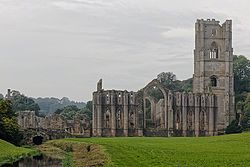
Fountains Abbey

Fountains Abbey is a ruined Cistercian monastery near Ripon in North Yorkshire, England. It was founded in 1132 under the direction of Thurstan, archbishop of York, and over the next four centuries became one of the wealthiest monasteries in England thanks to its large and diverse landholdings. The monastery was dissolved in 1539 as part of the English Reformation and its estates sold. Fountains Abbey is now within Studley Royal Park, a landscaped garden created in the eighteenth century. Even in its current state, Fountains is described by Historic England as "the best preserved of English abbeys and [...] the finest picturesque ruin." The majority of the buildings were constructed in the Romanesque and Early English Gothic style between 1170 and 1247, with significant additions in the late fifteenth and early sixteenth centuries. The abbey church and many of the claustral buildings survive, including the chapter house, refectory, and lay brothers' dormitory, as well as ancillary structures such as the guest houses, abbey mill, and bridges. The abbey is protected for its historic significance, having been designated a grade I listed building and a scheduled monument by Historic England. It also forms part of the Studley Royal including the ruins of Fountains Abbey World Heritage Site. It is owned by the National Trust and maintained by English Heritage, and is open to the public.