

 English
 Français
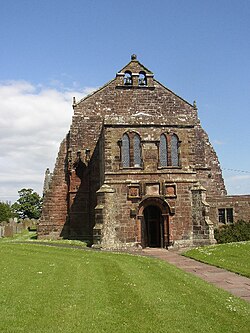
St Mary's Church, Abbeytown
St Mary's Church is in the village of Abbeytown, Cumbria, England. It is an active Anglican parish church in the deanery of Solway, the archdeaconry of West Cumberland, and the diocese of Carlisle. Its benefice is united with those of six local churches to form the Solway Plain Team Ministry. The church is recorded in the National Heritage List for England as a designated Grade I listed building.
Nearby Places View Menu
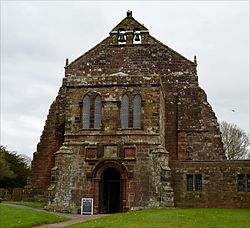
0 m
Holmcultram Abbey
Holmcultram Abbey (alternatively Holm Cultram Abbey or Holme Cultram Abbey) was a Cistercian monastery in what is now the village of Abbeytown in Cumbria, England.
Founded in 1150, the abbey was suppressed in 1538 during the Dissolution of the Monasteries. The former monastic church remains in use as a parish church (St Mary's Church, Abbeytown) and a place of worship.

312 m
Abbey Town railway station
Abbey Town railway station was on the branch line off the Solway Junction Railway in the English county of Cumberland (later Cumbria). The first station after Abbey Junction on the branch to Silloth on the Solway Firth, it served the village of Abbey Town. The station closed with the line to Silloth in 1964.
317 m
Abbeytown
Abbeytown is the main village in the civil parish of Holme Abbey in the Cumberland district of Cumbria, England. The parish was historically called Holme Cultram. The modern names of Abbeytown and Holme Abbey both reference Holmcultram Abbey, which was founded in 1150 and dissolved in 1538; the surviving nave from the abbey now serves as the parish church. The parish of Holme Abbey had a population of 757 at the 2021 census.

317 m
Solway Plain
The Solway Plain or Solway Basin is a coastal plain located mostly in northwest Cumbria in England, extending just over the Scottish border to the low-lying area around Gretna and Annan. It lies generally north and west of Carlisle along the Solway Firth, and is drained by the rivers Esk and Lyne. It is associated with the westernmost part of Hadrian's Wall. In medieval times, clay houses known as dabbins were commonly built on the Solway Plain. The Solway coast has been designated an “Area of Outstanding Natural Beauty”.
The plain is known for its archaeological heritage. Archaeological finds that are mentioned in Hodgson and Brennand include urned cremation cemeteries at Ewanrigg, evidence suggesting an ancient domestic settlement at Plasketlands, and evidence suggesting pre-Roman occupation at Ewanrigg, Wolsty Hall and Boustead Hill (among other sites). Salta Moss, where a Bronze Age rapier was discovered, boasts flora that is unusual for a mire on the Solway Plain, and has been designated a “Site of Special Scientific Interest” since 1982. As the presence of Hadrian's Wall attests, the Solway Plain is also known for its history as a disputed borderland, control of which was often fought over — from the Roman occupation of Britain to the Border Reivers and Anglo-Scottish conflicts in the Middle Ages.