


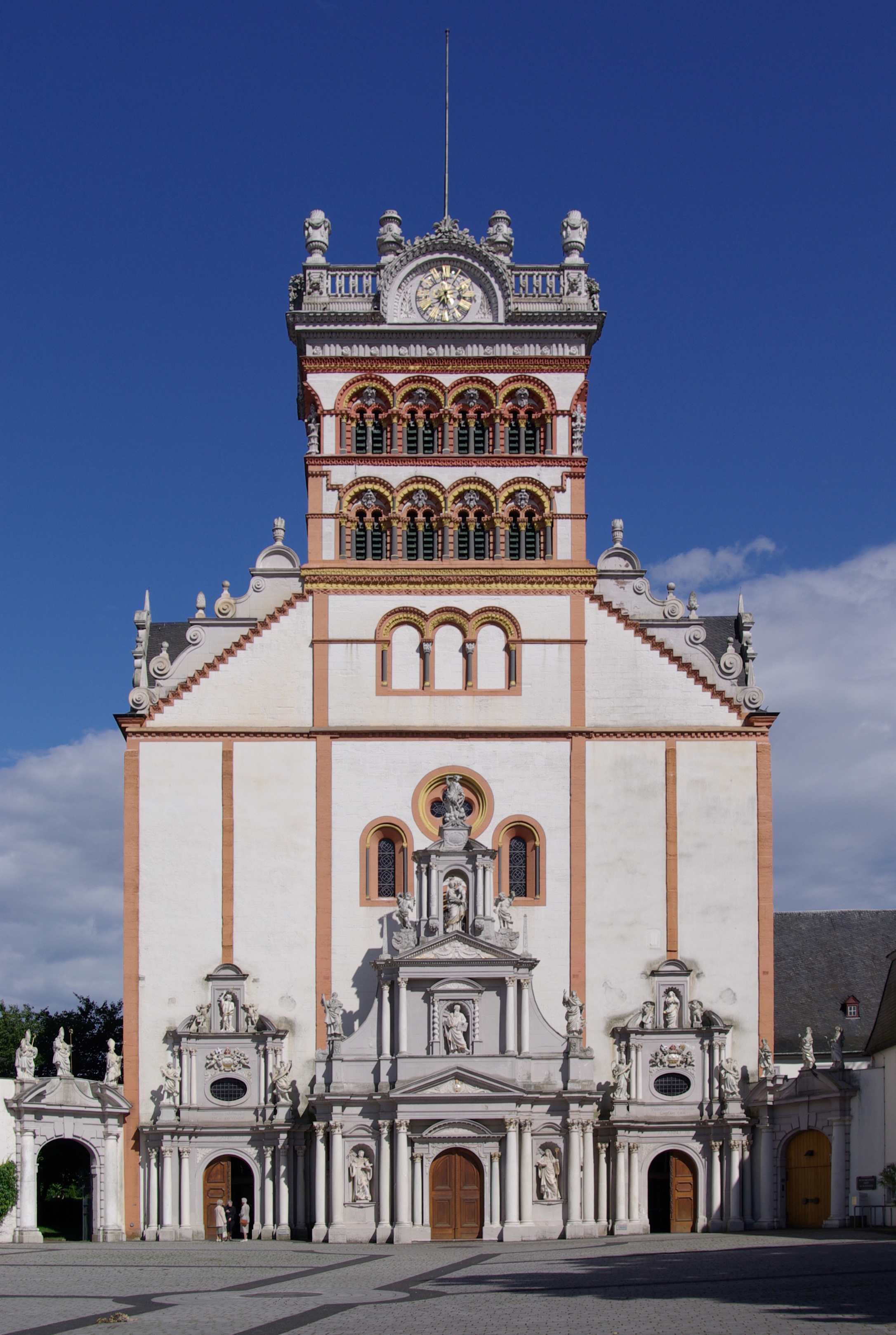
L’abbaye Saint-Matthias est une abbaye bénédictine masculine appartenant à la congrégation de l'Annonciation (Congregatio Annuntiationis BVM), dont elle est l'archi-abbaye. Elle se trouve à Trèves en Allemagne.
Book your tour near
Abbaye Saint-Matthias de Trèves
Book Now
4.3
in partnership with
GetYourGuide.com
Gallery




Sponsored
Location

5 m
St. Matthias' Abbey is a Benedictine monastery in Trier, Rhineland-Palatinate, Germany, that belongs to the Congregation of the Annunciation.
The abbey church, a Romanesque basilica, is a renowned pilgrimage site because of the tomb of Saint Matthias the Apostle, after whom the abbey is named, located here since the 12th century, and the only burial of an apostle in Germany and north of the Alps. The abbey was originally named after Saint Eucharius, first Bishop of Trier, whose tomb is in the crypt. The church has been given the status of a minor basilica.

1.3 km
Sarre was a department in the First French Republic and First French Empire. Its territory is now part of Germany and Belgium. Named after the river Saar, it was created in 1798 in the aftermath of the Treaty of Campo Formio of 18 October 1797 which ceded the Left Bank of the Rhine to France.
Despite its name it covered a much larger area than the historical area known as the Saarland. Prior to the French occupation of the area from 1793 onward, its territory had been divided between the Electorate of Trier, Nassau-Saarbrücken and the Electorate of the Palatinate. Its territory is now part of the German states Rhineland-Palatinate and Saarland as well as a tiny adjacent section of the Belgian province of Liège. Its capital was Trier.
The department was subdivided into the following arrondissements and cantons:
Trier, cantons: Bernkastel, Büdlich, Konz, Pfalzel, Saarburg, Schweich, Trier and Wittlich.
Birkenfeld, cantons: Baumholder, Birkenfeld, Grumbach, Hermeskeil, Herrstein, Kusel, Meisenheim, Rhaunen and Wadern.
Prüm, cantons: Blankenheim, Daun, Gerolstein, Kyllburg, Lissendorf, Manderscheid, Prüm, Reifferscheid and Schönberg.
Saarbrücken, cantons: Blieskastel, Lebach, Merzig, Ottweiler, Saarbrücken, Sankt Wendel and Waldmohr.
Its population in 1812 was 277,596, and its area was 493,513 hectares.
After Napoleon was defeated in 1814, most of the department became part of Prussia, with smaller parts assigned to Duchy of Oldenburg and Bavaria. The cantons of Sankt Wendel and Baumholder were given to Saxe-Coburg-Saalfeld as the Principality of Lichtenberg, which was sold to Prussia in 1834. The canton of Meisenheim was given to Hesse-Homburg, which was annexed to Prussia in 1866. France retained Saarbrücken but, after Waterloo, it was punished and it lost the town together with Saarlouis from nearby Moselle. The former Schönberg canton would later be included in the Eupen-Sankt Vith-Malmedy plebiscite area following World War I.

1.3 km
The Roman Monuments, Cathedral of St. Peter and Church of Our Lady in Trier are buildings and monuments of particular historical importance in Trier, Germany, that were together listed as a UNESCO World Heritage Site in 1986. These sites demonstrate the political, economic, and historical importance of Trier during the Roman Empire as one of the four capital during the Tetrarchy period, and as a prominent city during the early days of the Holy Roman Empire in the Middle Ages.
From UNESCO/CLT/WHC:
"Trier is an example of a large Roman capital after the division of the empire. The remains of the Imperial Palace, in addition to the Aula Palatina and the Imperial Thermae, are impressive in their dimensions. The city bears exceptional testimony to Roman civilization owing to the density and the quality of the monuments preserved: the bridge, the remains of the fortified wall, thermae, amphitheatre, storehouses, etc. In particular, funerary art and the craftsmanship of potters, glassworkers, and moneyers flourished in the city."
In 2009, the site was featured on a golden 100-Euro coin.
1.3 km
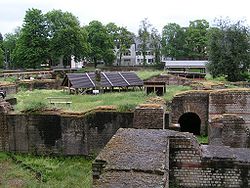
The Barbara Baths are a large Roman bath complex in Augusta Treverorum, modern-day Trier, Germany. Stretching over 42,000 square meters, it is the largest Roman bath north of the Alps. Along with other sites in Trier, the bath complex was designated a UNESCO World Heritage Site in 1986 as part of the Roman Monuments, Cathedral of St. Peter and Church of Our Lady in Trier site, because of its historical importance and sprawling architecture.

1.5 km
The Trier Imperial Baths are a large Roman bath complex in Trier, Germany. The complex was constructed in the early 4th century AD, during the reign of Constantine I. During that time, Trier was a major imperial hub, being a primary residence for Constantine's son Crispus. The baths were built around hot water pools reaching 40°C. Underneath the complex was a network of underground passageways used by the staff which can still be seen today, along with the remains of the sewer system. However, the baths were never completed and were made into a castle in the Middle Ages.
Book your tour near
Abbaye Saint-Matthias de Trèves
→