

 English
 Français

Otterburn (Yorkshire du Nord)
Otterburn est un village et une paroisse civile du Yorkshire du Nord, en Angleterre.
Nearby Places View Menu
0 m
Otterburn, North Yorkshire
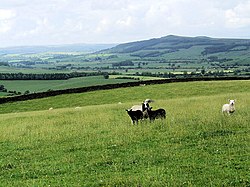
Otterburn (historically known as Otterburn-in-Craven) is a village and civil parish in the county of North Yorkshire, England. It is at OS Grid Reference SD8857, near Airton, Calton and the A65. The village is 9 miles (14 km) north west of Skipton and 1.9 miles (3 km) east of Hellifield.
At the 2011 census the population was less than 100, so the details are included in the civil parish of Airton.
2.0 km
Aire Gap
Aire Gap is a pass through the Pennines in England formed by geologic faults and carved out by glaciers. The term is used to describe a geological division, a travel route, or a location that is an entry into the Aire river valley.

2.3 km
Bell Busk railway station
Bell Busk railway station served the hamlet of Bell Busk in North Yorkshire, England. It was located on the Leeds to Morecambe Line between Gargrave and Hellifield, 32+3⁄4 miles (53 km) north of Leeds.

2.3 km
Airton
Airton (also known as Airton-in-Craven) is a small village and civil parish in North Yorkshire, England, situated 10 miles (16 km) north-west of Skipton. The village had a population of 175 according to the 2001 Census, 228 at the 2011 Census, decreasing to 227 at the 2021 Census.
Until 1974 it was part of the West Riding of Yorkshire. From 1974 to 2023 it was part of the district of Craven, it is now administered by the unitary North Yorkshire Council.

2.4 km
Airton Quaker Meeting House
The Airton Quaker Meeting House is a historic religious building in Airton, a village in North Yorkshire, in England.
As a vernacular building, the origin of the meeting house is uncertain. The National Churches Trust argues that it was purpose-built in the early 1600s as a meeting house for the Seekers, an early group of religious dissenters. By the time of the English Civil War, the land on which the building stands was owned by John Lambert, a military commander who was sympathetic to the new Quaker movement. George Fox may have preached in Airton in 1652, while another Quaker leader, Gervase Benson, definitely preached in the village by 1658, in what he described as a "barn-like building". A Quaker community became established in the village, with the first recorded burial in 1663, and regular meetings by the end of the decade.
The building appears to have originally been a cruck barn In about 1694, the building was reconstructed, the work being funded by William Ellis, a local linen manufacturer. The building thereafter served as a Quaker meeting house; it is unclear whether it was the barn mentioned by Benson, but if its history is as given by the National Churches Trust, it is the oldest surviving Quaker meeting house.
In 1700, William Ellis and his wife Alice bought the building from Lambert for £31, and the door lintel was inscribed with the date to commemorate the transaction. The building was repeatedly altered over the following centuries, but retained its basic form. Regular worship continued until World War II, when two evacuee families were housed in the building. After the war, meetings were held only twice or three times a year, and the building fell into disrepair. By 2000, part of the roof had collapsed, and the walls were cracked, allowing damp in. Local Quakers decided to reinstate regular meetings, and gradually restored the building.
The building was Grade II listed in 1958, and was upgraded to Grade II* in 2020.
The building is constructed of limestone and sandstone rubble, on a plinth of boulders, and has a slate roof. It is rectangular in plan, and is divided into a main meeting room and a smaller room, originally the women's meeting room. The two are separated by a timber partition, with a gallery above, reached by steps, the structure appearing to date from around 1700. There is a cottage attached. The south-east windows appear to date from the early 18th century, and a large one on the north-west side is 19th-century. On the north-east side is a chimney stack, with two early 18th century fireplaces. Inside, there is a long stone elders' bench, which is likely to date from the 1690s.
There is a rubblestone archway attached to the north-east wall, which is included in the meeting house's listing. Also attached is the early 18th century warden's house, now named The Nook. Beyond the house is a former barn and hayloft, and there is also a burial ground, with rubblestone walls. These are listed at grade II, with the house and barn.