


Old Town Manchester is a neighborhood in Richmond, Virginia's Southside quadrant. The neighborhood is where downtown Manchester, Richmond, Virginia, United States, was situated before the city merged with Richmond. The area is heavily industrialized, but has gone through a series of gentrification for the last 10 years. Several lofts and art galleries have opened in the area.
Location
1 explorer visited this place
557 m
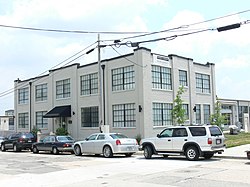
Southern Stove Works, Manchester is a historic factory complex located in Richmond, Virginia that replaced the company's original factory. The complex includes two contributing prefabricated steel frame buildings built in 1920. The west building contains the original two-story office building that has been connected by one-story infill to the long one-story warehouse building that contained the pressing and mounting departments and a three-part warehouse. The office is a five-by-three-bay, two-story, building measuring 40 by 80 feet and brick curtain walls. The east building today consists of the foundry with attached original washrooms and office, charging room, and an expanded mill room.
It was listed on the National Register of Historic Places in 2008.

621 m
The James River Bridge carries Interstate 95 across the James River in Richmond, Virginia.

702 m
Hull Street Station was a railroad station in the city of Richmond, Virginia. It was built by the Southern Railway to replace Mill Street Station across the river in Richmond. The station, which had been closed, was damaged in several floods of the James River before Richmond's flood wall was completed in 1995. Since 2011, it has been the site of the Richmond Railroad Museum.

807 m
Mayo's Bridge is located in Richmond, Virginia. A four lane structure, it transports U.S. Route 360 across the James River. Signage identifies the bridge as "Mayo's Bridge".
The bridge is in two sections, separated near the middle by Mayo's Island. The total length is 1,374 feet.
The current structure was built in 1913, and accommodated heavy streetcar traffic. It is Richmond's oldest highway bridge across the James River.
Prior to the construction of Mayo's Bridge, travelers had to utilize Coutts' Ferry, run by Patrick Coutts until his death in 1776 and later by his brother Rev. William Coutts until his death in 1787. The ferry landing was at a place called the "Sandy Bar" at the end of 18th Street. The ferry was kept up for many years after the bridge was built as the 6.25¢ toll was impressive and the bridge was often broken, thus necessitating the ferry. Patrick Coutts was something of a legend in old Richmond. This stemmed from the story that he had crossed the river not by ferry or bridge, but by sturgeon.
Many people petitioned the Virginia Assembly for the right to build a bridge, but none were successful in receiving permission. Around the mid-1780s, John Mayo, son of William Mayo, was given the opportunity to build a toll bridge but died soon after. His son, John Mayo Jr., inherited his estate and finally completed the first bridge across the James in 1788. This bridge was very rudimentary and consisted of “large logs, raft-like, spiked to the rocks, with rough floor laid on the logs” on the north side of Mayo's Island and of a pontoon bridge that had planks laid on top of a series of boats on the south side. This bridge was destroyed the winter after its completion by ice floes dragging the bridge away. It was destroyed and subsequently rebuilt in 1814, 1816, 1823, 1865, 1870, 1877, 1882, and 1899.
It was built on the site of the city's first bridge completed in 1788 by John Mayo Jr., the grandson of the man who first laid out Richmond's grid pattern. During the American Civil War the bridge was burned by retreating Confederate soldiers on April 8, 1865.
In 1882, the a portion of the bridge collapsed with nine people on it; however, no one was killed or badly hurt in the incident.
Rising just 30 feet above the water line, Mayo's Bridge is currently Richmond's only bridge subject to flooding. Large floodgates in Richmond's flood wall protect the surrounding areas on each side during James River flooding. The bridge's closeness to the river surface has made the sidewalks on either side of it popular fishing locations.

836 m
William R. Trigg Company, also the Trigg Shipbuilding Company, was an inland shipyard in Richmond, Virginia. The shipyard produced torpedo boats and destroyers and the protected cruiser USS Galveston for the United States Navy. It was founded by William R. Trigg, who also owned the Richmond Locomotive Works in 1899. The yard went into receivership and ceased operations by 1903, the same year its founder died.
See also
Manchester, Richmond, Virginia Neighborhoods of Richmond, Virginia Southside (Richmond, Virginia)
Book your tour near
Old Town Manchester
Book Now
4.0
in partnership with
GetYourGuide.com