
Location Image

22 South William Street

22 South William Street is a home in Perth, Scotland. Located on South William Street, one block north of the South Inch, it is a Category C listed building, built in the early 19th century. A two-storey structure, it is three bays with a piend roof. It has a large pilastered and corniced doorpiece. Its exterior walls are painted rubble with dressings in ashlar. At the rear is a full-height bowed stair projection with a coned cap. A small walled garden at the rear adjoins the wall of the viaduct embankment of the Perth to Dundee railway. In 2009, the home was converted from a single-family to twin occupancy. Historic Environment Scotland describes the property as "a good, representative example of early 19th century villa construction" and its little-altered exterior "[adds] to its interest and to the architectural and historic value of the wider setting".

Nearby Places View Menu
Location Image
122 m

Perth Princes Street railway station

Perth Princes Street railway station served the city of Perth, Perth and Kinross, Scotland, from 1847 to 1966 on the Dundee and Perth Railway.
Location Image
170 m

St John the Baptist Episcopal Church, Perth
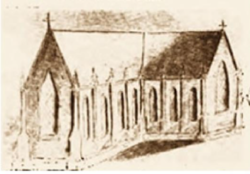
St John the Baptist Church is located in Perth, Perth and Kinross, Scotland. Of Scottish Episcopalian denomination, it is located on Princes Street, at its junction with Canal Street, in the southeastern corner of the city centre. It adjoins the Greyfriars Burial Ground on its western side. Completed in 1851, it is now a Category B listed building. The church's architects were John Hay, William Hardie Hay and James Murdoch Hay, three brothers from Liverpool. Andrew Granger Heiton, nephew of Andrew Heiton, made additions in 1914. The site on which the church stands was purchased in 1795, on the condition that a place of worship for Church of England services be its only use. The chapel constructed that year was demolished in 1850 to make way for today's structure.
Location Image
194 m

Greyfriars, Perth

The Observant Order of Greyfriars (or Greyfriars) was a friary of the Franciscan Order located in the Scottish city of Perth. It was founded by Laurence Oliphant, 1st Lord Oliphant, in 1496 and destroyed on 11 May 1559 following the Scottish Reformation, started by John Knox in his sermon at Perth's St John's Kirk, just a few hundred yards to the north. The monastery's location is now partly occupied by the Greyfriars Burial Ground, established in 1580. In 1997, when proposals were made to dismantle and rebuild the cemetery's eastern wall, two test pits were dug by the Scottish Urban Archaeological Trust (SUAT). One of the pits found what is believed to be the original monastery wall foundations. A "succession of wall foundations" hinted at several wall replacement and repair efforts undertaken during the monastery's lifespan, each raising the ground level. Medieval pottery was also discovered, likely associated with the soil of lower garden abutting the original monastery wall. The other pit demonstrated a lack of a progression of wall foundations, confirming that that area was inside the 1795 graveyard extension and outside the original monastery grounds. The second pit also showed signs of infilling or levelling layers, possibly from when a burn, which ran along the burial ground's southern wall, was covered with soil.
Location Image
194 m

Greyfriars Burial Ground

Greyfriars Burial Ground is an historic cemetery in Perth, Scotland. Dating to 1580, it is now Category A listed, with its collection of gravestones considered one of the best in Scotland. The cemetery closed to burials in 1978. The cemetery occupies the former location of the Greyfriars Monastery, founded by Laurence Oliphant, 1st Lord Oliphant, in 1496 and destroyed in 1559 at the start of the Scottish Reformation. As per documentation dating to 1911, "no burial is permitted of the body of a person who at the time of death resided out of the old parish, excepting that of a widower or widow, son or daughter who have never been married." A superintendent was in attendance every morning between 10 and 11 AM, then between 11 AM and 1 PM at Wellshill Cemetery. The cemetery is located at the eastern end of Canal Street, near its junction with Tay Street. It has been extended south on two occasions, and it now abuts the bridge carrying the Perth-to-Dundee section of the Scottish railway network. Also on the southern side of the cemetery is a roofed section under which are thirteen early gravestones. Moved for conservation purposes, they include the oldest gravestone in the cemetery (Buchan, 1580). A tablet commemorating John Mylne, who "rebuilt the ancient bridge over the River Tay," was erected by Robert Mylne in 1784. In 1997, when proposals were made to dismantle and rebuild the cemetery's eastern wall, two test pits were dug by the Scottish Urban Archaeological Trust (SUAT). One of the pits found what is believed to be the original monastery wall foundations. A "succession of wall foundations" hinted at several wall replacement and repair efforts undertaken during the monastery's lifespan, each raising the ground level. Medieval pottery was also discovered, likely associated with the soil of lower garden abutting the original monastery wall. The other pit demonstrated a lack of a progression of wall foundations, confirming that that area was inside the 1795 graveyard extension and outside the original monastery grounds. The second pit also showed signs of infilling or levelling layers, possibly from when a burn, which ran along the burial ground's southern wall, was covered with soil. In 2019, several headstones deemed a hazard to passersby were removed and restored. Perth and Kinross Council have left the grass outwith the paths around the graveyard to grow as a biodiversity plan.