

 English
 Français
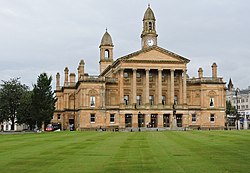
Paisley Town Hall
Paisley Town Hall is a public hall in Abbey Close, Paisley, Renfrewshire, Scotland. The building, which is being converted into a centre for performing arts, is a Category A listed building.
Nearby Places View Menu

87 m
Paisley Abbey
Paisley Abbey is a parish church of the Church of Scotland on the east bank of the White Cart Water in the centre of the town of Paisley, Renfrewshire, about 7 miles (11 kilometres) west of Glasgow, in Scotland. Replacing a church of the 8th century, the abbey church was founded as a Cluniac priory in 1163, with the present Gothic building dating from the 14th and 19th centuries. Following the Reformation in the 16th century, it became a Church of Scotland parish kirk.

112 m
Glen Cinema disaster
The Glen Cinema disaster was a deadly crowd crush caused by a smoking film canister at a cinema in Paisley, Renfrewshire, Scotland, on 31 December 1929. The resulting panic and crush killed 69 children and injured up to 40 others; the final death toll was 71. It is considered one of the worst disasters in Scottish history. The building that housed the Glen Cinema still stands and, as of 2015, houses a furniture store.

130 m
Paisley, Renfrewshire
Paisley ( PAYZ-lee; Scots: Paisley; Scottish Gaelic: Pàislig [ˈpʰaːʃlɪkʲ]) is a large town situated in the west central Lowlands of Scotland. Located north of the Gleniffer Braes and immediately west of Glasgow, it straddles the banks of the White Cart Water, a tributary of the River Clyde. It serves as the administrative centre for the Renfrewshire council area, and is the largest town in the historic county of the same name. It is often cited as "Scotland's largest town" and is the fifth largest settlement in the country, although it does not have city status.
The town became prominent in the 12th century, with the establishment of Paisley Abbey, an important religious hub which formerly had control over other local churches. Paisley expanded significantly during the Industrial Revolution as a result of its location beside White Cart Water, with access to the Clyde and nearby ore, mineral and agricultural resources. Factories and mills developed leading to an increase in the town's population. The town's associations with political radicalism were highlighted by its involvement in the Radical War of 1820, with striking weavers being instrumental in the protests.
By the late 19th century, Paisley was a global centre of the weaving industry, giving its name to the Paisley shawl and the Paisley pattern. However, industrial decline followed in the 20th century. By 1993, all of Paisley's mills had closed, although they are memorialised in the town's museums and civic history. The town now functions as a regional centre for local governance and services as well as a residential commuting area within the Greater Glasgow urban region.

141 m
Paisley War Memorial
Paisley War Memorial, also known as Paisley Cenotaph, is a war memorial in at the centre of Paisley, Renfrewshire, Scotland. It was unveiled in 1924, became a Category B listed building in 1980, and was upgraded to Category A in 1997.
The memorial was commissioned after the First World War, following an open competition which attracted 195 entries. A public subscription raised funding of £14,000 to build the memorial.
It comprises a bronze equestrian sculptural group on a 25 ft (7.6 m) high rectangular stone plinth. The plinth rises on four steps from a stone platform with a retaining wall on three sides, open to the west. The structure was designed by the architect Sir Robert Lorimer, and constructed by Neil McLeod & Sons Limited with stone carving by Allen & Sons, using about 200 tons of grey granite imported from Shap Fell in Cumbria.
The bronze sculpture group stop the plinth, about 3 m (9.8 ft) high and weighing about 4.5 tons, was designed by Alice Meredith Williams and cast by JW Singer & Sons. Williams had given her competition entry the title "The Spirit of the Crusaders": a model created for the competition is held by the National Museum of Wales in Cardiff. It depicts a medieval knight in armour mounted on a horse, accompanied by four infantry soldiers in First World War battledress, with muddy boots, greatcoats, and helmets. The knight carries a shield and pennant bearing the St Andrew's saltire for Scotland.
The arms of the burgh of Paisley, of St Andrew, and of St George, are carved into the front (south) and rear (north) faces of the plinth, and bronze plaques are mounted on the east and west faces. Towards the bottom of the south face of the plinth, the stone bears an inscription which reads "TO THE GLORIOUS MEMORY/ OF THE 1,953 MEN OF PAISLEY/ WHO GAVE THEIR LIVES ON LAND/ AND SEA IN THE GREAT WAR". After the Second World War, a further inscription as added "AND IN GRATEFUL REMEMBRANCE OF THE/ MEN AND WOMEN OF THIS BURGH WHO/ GAVE THEIR LIVES FOR THEIR COUNTRY/ IN THE WORLD WAR 1939-1945".
The memorial was unveiled on 27 July 1924, before a crowd of 20,000 people, by Mrs Macnab, a widow who lost three sons in the Great War. Prayers were led by Rev. Dr A M MacLean, of Paisley Abbey, accompanied by the Provost Glover and the former Provost John Robertson who was chairman of the War Memorial Committee.
After this memorial, Williams collaborated with Lorimer on sculptures for the Scottish National War Memorial in Edinburgh.