

 English
 Français
Lady Lumley's School
Lady Lumley's School is a coeducational secondary school and sixth form located in Pickering, North Yorkshire, England. It was founded in Thornton-le-Dale in 1670. It was endowed by deed of Frances, Viscountess Lumley, an ancestor of the Earl of Scarborough, in 1657, and the buildings completed in about 1680. It has school links worldwide, particularly within Tanzania, Morocco, China and France. The school has been awarded Sportsmark 2008, an iNET qualification, Specialist Schools and Academies Trust, a British Schools Orienteering award and was classified as a Healthy School. In 2019, the Ofsted Inspection Report rated Lady Lumley's school as inadequate.
Nearby Places View Menu

558 m
St Joseph's Church, Pickering
St Joseph's Church is a Catholic church in Pickering, North Yorkshire, a town in England.
Mass was said at Pickering in the 17th century by Nicholas Postgate, but services then lapsed and were only revived in 1896, when a priest from Malton began saying mass at the town's Salvation Army hall. In 1901, Father Edward Bryan moved to the town and purchased two cottages, using one as a chapel. He raised funds for a church, which was completed in 1911, to a design by Leonard Stokes. The church was grade II listed in 1975, along with the church hall
The church is built of stone with a tile roof, and consists of a nave, a north aisle, and a tower at the junction of the church and the hall. The hall is at a right angle and has a stone porch with a gambrel roof, a large Perpendicular-style window to the south, and hipped dormers on the roof. There is a statue of Saint Joseph on the south wall, believed to be by Peter Paul Pugin. Inside, there is an octagonal font carved by Eric Gill, and a stone altar with a cross also said to be by him. Other features include a carved holy water stoup and plain oak benches.
571 m
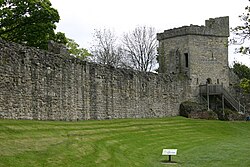
Pickering Castle
Pickering Castle is a motte-and-bailey fortification in Pickering, North Yorkshire, England. The original castle was made of timber, and the later stone castle was a temporary prison for Richard II in 1399.
The castle is owned by the Duchy of Lancaster and managed by English Heritage.

571 m
Pickering Quaker Meeting House
Pickering Quaker Meeting House is a historic building in Pickering, North Yorkshire, a town in England.
A Quaker meeting house was first built in Pickering in about 1675, on a site on Undercliff. In 1793, a new, larger, meeting house was built on a site above Undercliff. Meetings ended in 1843, but the building remained in Quaker ownership, and it was refurbished in 1879. Meetings restarted in 1936. In 1945, cloakrooms were added, and a wooden hut from Pickering Golf Club was erected next to the meeting house, to serve as a hostel, but was later demolished. In 1976, an extension was added to house a kitchen, which was later enlarged. The building has been grade II listed since 1974.
The building is built of stone with a hipped Welsh slate roof. There is one storey, a rectangular plan, and three bays. The porch has a coped gable and an elliptical-headed entrance with a keystone and impost blocks. The windows are sashes with flat lintels and incised keystones. Inside, there are larger and smaller meeting rooms separated by a passage, the passage and smaller meeting room with fittings from 1879, and the larger meeting room with fittings from the late 20th century, and a gallery which can be accessed only by a ladder.

609 m
Beck Isle Museum
The Beck Isle Museum of Rural Life is a social history museum in Pickering, North Yorkshire, England. The museum features period business displays including the shops of a barber, blacksmith, chemist, cobbler, cooper, printer, gentleman's draper, dairy, and hardware store. There is also a Victorian-era pub and parlour, and a historic costume gallery.
Its collection is housed in a fine regency period Grade II* listed mansion with farm outbuildings. Among the collections are the photography and photographic equipment of Sydney Smith (1884–1958), noted photographer of Pickering. Despite poor eyesight due to a childhood affliction with measles, Smith developed a love of photography, opening a photographic business in the 1900s and operating it with his wife, Maud, until World War I. Maud ran the shop while Smith fought in World War I, and after his return from the war he "gave up photography in order to run a garage on Park Street", though he continued to "spend all his spare time taking photographs".
The images from the collection number several thousand, and a number are on display throughout the museum. Most of the images date from the 1920s to the late 1940s and are of Pickering and the surrounding villages, events, and local people. Smith's collection was described in 2000 as presenting "a remarkable picture of the Rydale area as it was more than half a century ago."