


Petunia Pickle Bottom is an American manufacturer of diaper bags, handbags (branded only as "Petunia") and other women's accessories. The company was founded in 2000 in Ventura, California by DeNai and Braden Jones together with Korie Conant. Its products became fashionable in the U.S. after being featured on Oprah Winfrey's talk show.
Location
1 explorer visited this place

364 m
First Baptist Church of Ventura is a historic church at 101 S. Laurel Street in Ventura, California. It was built in 1926 and renovated extensively into the Mayan Revival style in 1932. Declared a landmark by the City of Ventura In 1975, the building was added to the National Register of Historic Places in 2009. Since 1952, it has been home to the Ventura Center for Spiritual Living.
According to its NRHP nomination, it was deemed nationally significant "as a fine and essentially unaltered example of a scarce property designed in the Mayan Revival style by its most prominent and widely-recognized proponent, architect Robert B. Stacy-Judd of Los Angeles. The First Baptist Church of Ventura exemplifies architectural exoticism by representing a moment in American architectural history when the public's desire for the new and different was at its peak. The property is the product of a rare convergence of national cultural events and a unique force of personality."
Some of his other notable Southern California commissions include the Aztec Hotel,, the Masonic Temple, the Philosophical Research Society, and the Atwater Bungalows,.
The other architect known for working in this style was Frank Lloyd Wright. In Los Angeles his Hollyhock House and Ennis House are relevant examples. The Imperial Hotel in Tokyo was a zenith of this style. His son, the landscape architect and architect Lloyd Wright, designed the John Sowden House in a similar style.

411 m
Plaza Park, also known as Cannon Park, is a public park in Ventura, California. It is the oldest park in Ventura and contains numerous historic landmarks like one of the state's oldest and largest Moreton Bay fig trees and a monumental cannon.

498 m
The Ventura Pier, previously known as the Ventura Wharf and the San Buenaventura Wharf, is a wooden pier located on the Pacific Ocean in Ventura, California. The pier has been designated as Ventura Historic Landmark No. 20. It is the oldest pier in California.
The pier was first built in 1872 and served for many years as a transportation hub and commercial wharf used to bring merchandise and lumber to the area and to export the area's agricultural products and crude oil. No longer used as a commercial wharf, it is used for fishing and as a pedestrian walkway with views of Ventura and the Channel Islands. It has been partially destroyed by storms and waves on several occasions and by collision with the steamer Coos Bay in 1914. From 1938 to 1995, it was the largest wooden pier on the California coast at a length of 1,958 feet. The pier is 1,600 feet long in its current configuration. The structure is a centerpiece of tourism promotion and hosts families, fishers, and tourists daily.

520 m
The Pierpont Inn is a Craftsman bungalow-style hotel in Ventura, California, United States, on a bluff overlooking the Santa Barbara Channel. Built in 1910 for motoring tourists, the complex is City of San Buenaventura Historic Landmark Number 80. Josephine Pierpont thought the site on a bluff overlooking the ocean could serve the increasing number of automobile enthusiasts who would travel along the Pacific Coast looking for a place to rest.
549 m
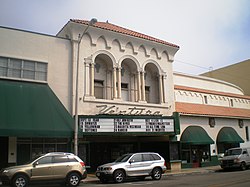
The Ventura Theatre is a historic live concert venue in downtown Ventura, California. This was "the only luxury theatre built in Ventura County in the 1920s in the "style of the great movie palaces." The lavish, elegant interior of gilt and opulence was originally designed by Robert E. Power Studios of San Francisco and has been restored. The theatre with a capacity of 1,150 and a flanking office building were designed by Lewis Arthur Smith in the Spanish Colonial Revival architecture that was favored by architects of motion picture theaters during the 1920s.
In 1928, Ventura was a bustling oil boom town when the grand opening featured an organ solo, the latest news, Our Gang comedies, a vaudeville act and the movie Excess Baggage. During the period between 1923 and 1929, many other buildings were constructed: the Hobson Brothers Meat Packing Company, the First National Bank of Ventura, the Ventura Hotel, the Elks Lodge - B. P. 0. E. #1430, the Mission Theater, the Hotel Washington, the Swift & Company Building, and the Masonic Temple. Contemporary downtown Ventura is defined by the theatre and the other extant buildings from this period.
Declared a landmark by the City of Ventura In 1976, the theatre was added to the National Register of Historic Places in 1986. The office building was modernized in 1958 and was not included in the historic designation. The theater currently has an active concert schedule.