


La gare de Flémalle-Grande est une gare ferroviaire belge de la ligne 125, de Liège à Namur, située à Flémalle-Grande section de la commune de Flémalle, en Région wallonne, dans la province de Liège. C'est une halte voyageurs de la Société nationale des chemins de fer belges (SNCB) desservie par des trains omnibus (L) et d'heure de pointe (P).
Gallery


Sponsored
Location
1.1 km
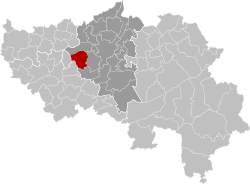
Flémalle is a municipality of Wallonia within the Liège Province in Belgium.
As of 2024, it has a population of 27,002, and together with the municipalities of Liège, Seraing, Herstal, Saint-Nicolas, and Ans, forms the Liège metropolitan area, with a total population of 381,340. Flémalle's geographical location, between valleys, Hesbaye, and Condroz, as well as between countryside and urban areas, offers a mix of nature, as seen in the locality of Gleixhe, and urban environments like its center or the suburb of Les Trixhes.
Despite its steep terrain, the municipality must address the increasing population in the metropolitan area; it is located near Seraing, highways, the Meuse, and the Liège Airport. To address this, the municipality has launched several large-scale projects, such as the construction of a brand-new neighborhood, Flémalle-Neuve, which is expected to be completed in a few years.
Historically, the municipality has witnessed the birth and advancement of paleontology and prehistoric studies thanks to Dr. Philippe-Charles Schmerling. A Roman diploma was also discovered in the area. During the Middle Ages, the municipality experienced economic prosperity due to the Prince-Bishopric of Liège, particularly in the village of Chokier, where a tsar, Peter the Great, and several generals from various empires stayed. During both World Wars, it played a crucial role in the defense of Liège with its fort.
André Cools is a historical figure in Flémalle's politics, but his influence extended beyond the municipality. He served as Minister of the Budget, Vice Prime Minister, President of the PSB, the PS, and the Walloon Parliament, before being assassinated in 1991.
Sports are also a significant source of recognition for the municipality, with several prominent athletes from the region and the country having connections to Flémalle. Notably, two kickboxing world championships have been held in the municipality. In team sports, ROC Flémalle is one of the top handball clubs in the country, with three Belgian Cups and eleven national titles.

1.1 km
The Fort de Flémalle is one of twelve forts built around Liège, Belgium, in the late 19th century. The overall Fortified Position of Liège was a constituent part of the country's National Redoubt. Fort de Flémalle was built between 1881 and 1884 according to the plans of General Henri Alexis Brialmont. Contrasting with the French forts built in the same era by Raymond Adolphe Séré de Rivières, the fort was built exclusively of unreinforced concrete, a new material, rather than masonry. The fort was heavily bombarded by German artillery in the Battle of Liège. Attacked in both World War I and World War II, the fort has been preserved as a museum.

1.2 km
The Decauville factory in Val-Saint-Lambert was a Belgian subsidiary of the French narrow-gauge railway manufacturer Decauville. It was founded in 1895 and taken over by the Berlin-based company O&K from 1911.

1.3 km
Val-Saint-Lambert Abbey was a Cistercian abbey in the Prince-Bishopric of Liège. It is situated in the Walloon municipality of Seraing, on the right bank of the Meuse, in Belgium, about 13 km south-west of Liège. Founded in 1202, the abbey's monks were expelled during the French Revolution. In the 19th century, the building ruins were converted into the Val Saint Lambert crystal factory. The structure is considered to be an important example of Cistercian architecture.
1.6 km
The Phenix Works is a steel working factory located in Flémalle-Haute, Liège, Belgium. The business was established in 1905 by Paul Borgnet and became part of SA Phenix Work in 1911. The works specialised in coated steels, such as galvanised, tin plate etc.
Acquired by Cockerill-Ougrée-Providence and later absorbed by its successor Cockerill-Sambre, as of 2016 the works is part of ArcelorMittal Liège, the Belgian subsidiary of ArcelorMittal.
