


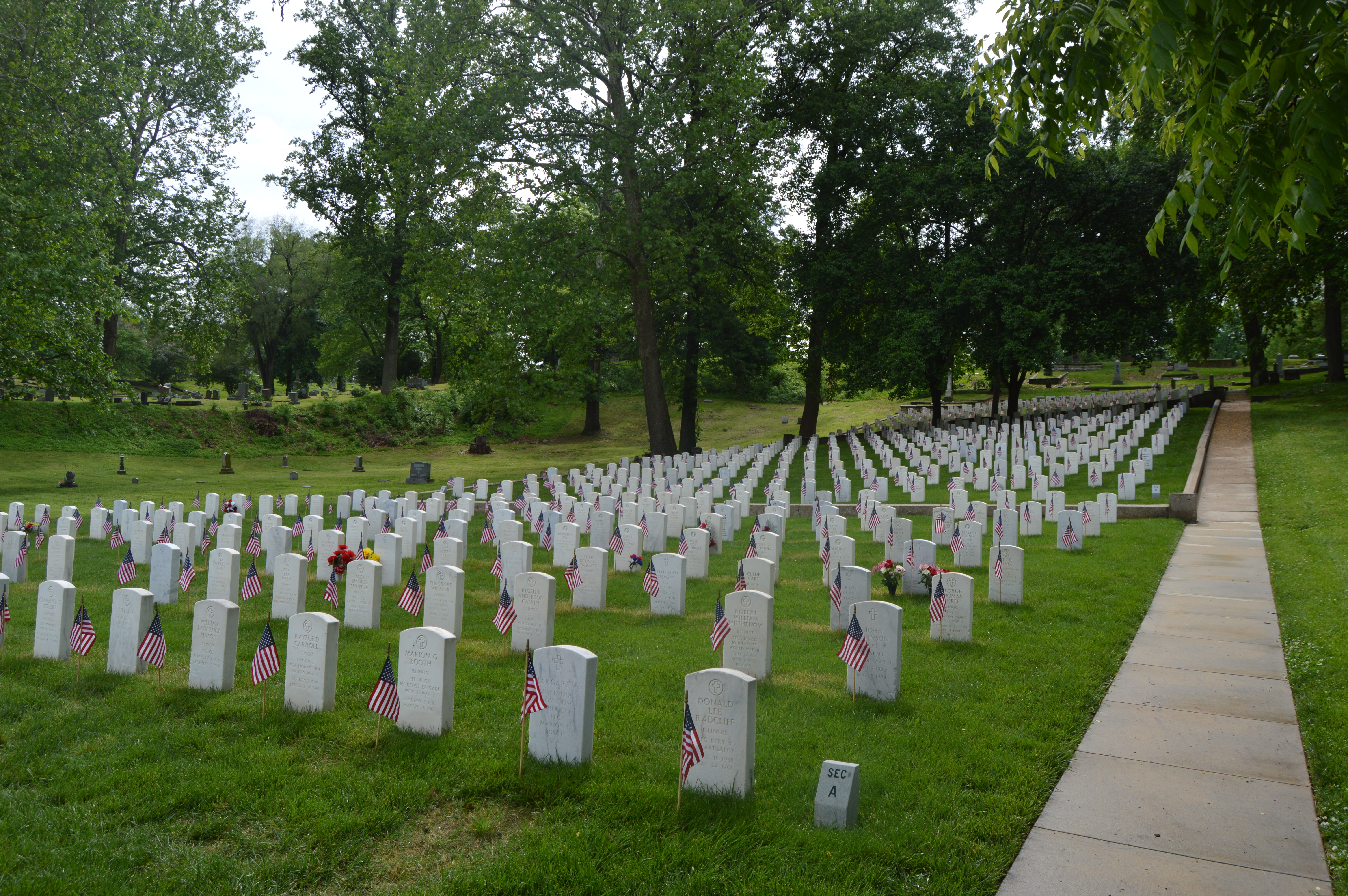
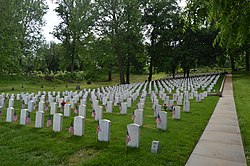
Le cimetière national d'Alton est un des cimetières nationaux des États-Unis situé dans la ville d'Alton, dans le comté de Madison, en Illinois. Administré par le département américain des anciens combattants, il comprend seulement une parcelle de 0,5 acres (0,2 ha) de terrain, et à la fin de 2005, contient 522 tombes.
Gallery

Sponsored
Location
1 explorer visited this place
24 m
Alton National Cemetery is a United States National Cemetery located in the city of Alton, in Madison County, Illinois. Administered by the United States Department of Veterans Affairs, it encompasses only half an acre plot of land, and as of the end of 2005, had 522 interments. It is maintained by the Jefferson Barracks National Cemetery, in St. Louis, Missouri.

226 m
The Elijah P. Lovejoy Monument, also known as the Elijah Lovejoy Monument, Elijah Parrish Lovejoy Shaft, Lovejoy Monument, and Lovejoy State Memorial, is a memorial in Alton, Illinois, to Elijah P. Lovejoy, an advocate of free speech and the abolition of slavery.
Lovejoy had moved his press across the Mississippi River to Alton after his offices were attacked three times by pro-slavery forces at his former location in St. Louis, Missouri. He hid the press in a warehouse before setting up his new operation but was attacked again on November 7, 1837. He was fatally shot that night when the warehouse was attacked and destroyed by a pro-slavery mob.
237 m
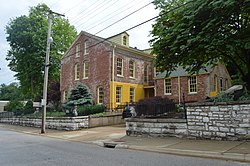
The Yakel House and Union Brewery are a historic house and brewery complex located at 1421-1431 Pearl St. in Alton, Illinois. Philip Yakel, a German immigrant, built the brewery soon after coming to America in 1836. The brewery was the first in Alton and one of the city's earliest successful industries. Yakel's son George, who eventually ran the brewery alongside his father, built the house in 1863; it was the family's second home at the site. The brick home features a vernacular design influenced by German architectural tradition. William Netzhammer, a brewer from St. Louis, purchased the brewery in 1882. The Netzhammer family ran the brewery until it closed in 1952;, notably, the brewery continued production during Prohibition by making near beer.
The complex was added to the National Register of Historic Places on May 11, 1982.

1.1 km
The Middletown Historic District is a historic district in Alton, Illinois. The primarily residential district includes portions of Alton's Middletown and Hunterstown neighborhoods and comprises 653 buildings, 613 of which are contributing buildings. Settlement in the district dates to the original plat of Alton in 1817, which included the southern half of Middletown. Development in the district continued through the 19th century and into the 20th, spanning all of Alton's early history. The district also represents multiple eras of Alton's architectural history. Most early houses in the district were designed in the Federal style, while the Italianate and Queen Anne styles were predominant in the latter half of the 19th century.
The district was added to the National Register of Historic Places on July 11, 1978. in 1982, the boundaries of the district were expanded to include Alton's Pagan Hill neighborhood. In January 2022, the boundaries were expanded again and now take in most of downtown Alton. The expanded area includes 134 new properties covering 11 blocks in the downtown area stretching from State Street to Ridge Street along Third Street, Broadway, and Front Street/Landmarks Boulevard.

1.2 km
Alton is a city on the Mississippi River in Madison County, Illinois, United States, about 18 miles north of St. Louis, Missouri. The population was 25,676 at the 2020 census. It is a part of the River Bend area in the Metro-East region of the Greater St. Louis metropolitan area.
It is well known for its limestone bluffs along the river north of the city. It's the former location of an historical state penitentiary, and played a significant role preceding and during the American Civil War. It was the site of the last Abraham Lincoln and Stephen Douglas debate in October 1858. The former state penitentiary in Alton was used during the Civil War to hold up to 12,000 Confederate prisoners of war.
Book your tour near
Cimetière national d'Alton
→
Il est maintenu par le cimetière national de Jefferson Barracks, à Saint-Louis, dans le Missouri.