Location Image

Yarrow Reservoir

Yarrow Reservoir – named after the River Yarrow – is a reservoir in the Rivington chain in Anglezarke, Lancashire, England, and has a storage capacity second to Anglezarke Reservoir. Construction of the reservoir, designed by Liverpool Borough Engineer Thomas Duncan, began in 1867. In 2002, several tons of fish were transported to this reservoir when the Upper Rivington reservoir was completely drained for essential maintenance work. The construction of Yarrow Reservoir was described in Wm. Fergusson Irvine's book A Short History of the Township of Rivington:

A suitable site for the embankment having been selected, a trench was excavated on the centre line of the intended work and carried down to the solid rock right across the valley. This was filled with clay deposited in layers of 9 inches, and carefully puddled so as to produce a homogeneous watertight material. This clay wall, having reached the natural surface of the ground, was continued through the embankment, which was also built in thin layers thoroughly rammed and consolidated on both sides of the clay centre. Before commencing the erection of the embankment all peat and unsound material were stripped from the site. The inner or water slopes of the embankment have been built to an angle of 3 to 1, and outer slopes to an angle of 2 to 1. The impermeability of the dam depends upon the wall of puddled clay in the heart of the dam tied into the solid rock at the bottom and sides of the valley. The clay wall has been carried up to a batter on each side of 1 inch to every foot vertical, the thickness at the top being 6 feet. The inner slopes of the bank are protected by 15-inch pitching, consisting of the millstone grit of the neighbourhood, laid on a bed of broken stone. The outer slopes have been soiled and grassed over. The construction of the reservoir meant that a small hamlet called Alance was flooded, centred on the rebuilt Alance Bridge, and a large dwelling was demolished - Turner's Farm - which lives on in current maps only in name as Turner's Embankment.

Nearby Places View Menu
Location Image
638 m

The Street (Heath Charnock)

The Street is a historical property on a bridleway of the same name in Heath Charnock in the Borough of Chorley, Lancashire, England. It is located on the western banks of the Upper Rivington reservoir and close to the boundary with the village of Rivington. It has been converted to apartments. Alexander Street took his name from the property when he was the owner of the estate in 1534. After his death, a distant cousin attempted to gain control of the building, but was evicted after a presumptuous attempt to act as a guardian to the deceased's children. After the reservoir was built in 1850, the house was demolished and rebuilt with compensation from Liverpool Corporation. In 1853, the property was owned by Peter Martin, who also owned Street Wood and Blindhurst Farm. Major renovation was undertaken, including vineries in the expansive gardens. Chorley Borough Council considered demolishing the structure following the demolition of many other large historic buildings in the village. It was rebuilt and although the roof was removed, the ornate and distinct chimneys remained. Opposite the property is a pets' grave, paying tribute to a trio of cats and dogs that died between 1900 and 1902.
Location Image
890 m

Upper Rivington Reservoir

Upper Rivington Reservoir is situated centrally in the Rivington chain of reservoirs, on the West Pennine Moors in Lancashire, England, between Rivington and Anglezarke. The engineer for the Rivington reservoirs was Thomas Hawksley and construction for Liverpool Corporation Waterworks took place between 1852 and 1857. The two dams of the Upper Rivington reservoir are the 292-yard (267 m) Horrobin Embankment that separates it from the lower reservoir and carries a road into the village from the west, and the 292-yard (267 m) long, 40 foot (12.2 m) high Yarrow Embankment. There is an island. A bridleway and residence, The Street are on the side of the reservoir. It is a popular walking destination, between Anglezarke Reservoir to the north, Lower Rivington Reservoir to the south, and Yarrow reservoir to the east. Street Bottoms and Street Wood were lost with the formation of the reservoir.
Location Image
1.2 km

Rivington

Rivington is a village and civil parish of the Borough of Chorley, Lancashire, England, occupying 2,538 acres (4.0 sq mi; 10.3 km2). It is about 6 miles (9.7 km) southeast of Chorley and about 8+1⁄2 miles (13.7 km) northwest of Bolton. Rivington is a rural area consisting primarily of agricultural grazing land, moorland, with hill summits including Rivington Pike and Winter Hill within the West Pennine Moors. The area has a thriving tourist industry centred around reservoirs created to serve Liverpool in the Victorian era and Lever Park created as a public park by William Lever at the turn of the 20th century, with two converted barns, a replica of Liverpool Castle and open countryside. Rivington and Blackrod High School is located here. Rivington and its village had a population of 109 at the 2011 Census.
Location Image
1.2 km

Rivington Unitarian Chapel

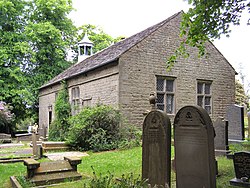
Rivington Unitarian Chapel is an active place of Unitarian worship in Rivington, Lancashire, England. It was founded in 1703, although its congregation dates to 1667. It is designated as a Grade II* listed building with some restoration in 1990, and hs ongoing preservation.