


The Egypt River is a stream in Ipswich, Massachusetts, United States. The river is formed by the confluence of Bull and Dow brooks below their reservoirs, and joins the Muddy River and then the Rowley River, which in turn empties into the Plum Island Sound. The Rowley River runs through salt marshes, in which it forms a narrow and winding inlet about 5.5 miles (8.9 km) in total length.
Location
1 explorer visited this place
1.2 km
Bradstreet Farm in Rowley, Mass. is believed to be the second-oldest continually operating farm in the U.S. Originally deeded by King Charles I of England to Humphrey Bradstreet in 1635, the property remained in the Bradstreet Family for many generations until 2007, when the Town of Rowley purchased the 120-acre parcel including a 19th century farmhouse and 18th century barn. The Town set aside 103 acres as conservation land, and sold seven acres including the farmhouse and barn as a private residence with historic preservation restrictions. The property is listed on the National Register of Historic Places.

1.7 km
The Platts-Bradstreet House, is a historic house museum at 233 Main Street in Rowley, Massachusetts. Its oldest portion dating to about 1677, it is a well-preserved example of First Period architecture, modified by repeated addition during the 18th century. The house has belonged to the Rowley Historical Society since the 1920s. It was listed on the National Register of Historic Places in 1980.

1.7 km
The Thomas Lambert House is a historic colonial First Period house in Rowley, Massachusetts, United States. It was listed on the National Register of Historic Places in 1990.
1.7 km
Rowley is a town in Essex County, Massachusetts, United States. The population was 6,161 at the 2020 census.
Part of the town comprises the census-designated place of Rowley.
1.8 km
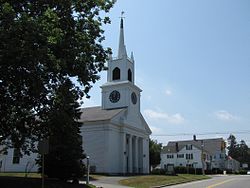
Rowley is a census-designated place in the town of Rowley in Essex County, Massachusetts, United States. The population was 1,416 at the 2010 census.
The name Egypt River is recorded as early as 1635. In early colonial times, it was also termed the North River. It was then a source of herring and smelt, but few have been observed since the 1970s.