

 English
 Français
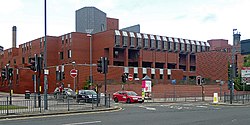
Leeds Combined Court Centre
Leeds Combined Court Centre is a Crown Court venue, which deals with criminal cases, and a County Court venue, which deals with civil cases, in Oxford Row, Leeds, West Yorkshire, England. It is adjacent to Leeds Magistrates Courts.
Nearby Places View Menu

78 m
Leeds School of Medicine
The School of Medicine is the medical school of the University of Leeds, in the city of Leeds, West Yorkshire, England. The School of Medicine was founded in 1831.
The School of Medicine now forms part of the University's Faculty of Medicine and Health. The School is composed of institutes located at multiple sites in West Yorkshire including the Worsley Building, LIGHT, St James's Campus, and Chapel Allerton Hospital. The School of Medicine is primarily linked with two major hospitals for clinical teaching: the Leeds General Infirmary and St James's University Hospital, both run by the Leeds Teaching Hospitals NHS Trust, alongside smaller district NHS Trusts.

120 m
City of Leeds
Leeds, also known as the City of Leeds, is a metropolitan borough with city status in West Yorkshire, England. The metropolitan borough includes the administrative centre of Leeds and the towns of Farsley, Garforth, Guiseley, Horsforth, Morley, Otley, Pudsey, Rothwell, Wetherby and Yeadon. It has a population of 845,189 (2024), making it technically the second largest city in England by population behind Birmingham, since London is not a single local government entity. Local governance sits with Leeds City Council and the city's 32 Town and Parish Councils.
The current city boundaries were set on 1 April 1974 by the provisions of the Local Government Act 1972, as part of a reform of local government in England. The city is a merger of eleven former local government districts; the unitary City and County Borough of Leeds combined with the municipal boroughs of Morley and Pudsey, the urban districts of Aireborough, Garforth, Horsforth, Otley and Rothwell, and parts of the rural districts of Tadcaster, Wharfedale and Wetherby from the West Riding of Yorkshire.
For its first 12 years the city had a two-tier system of local government; Leeds City Council shared power with West Yorkshire County Council. Since the Local Government Act 1985 Leeds City Council has effectively been a unitary authority, serving as the sole (aside from the 32 Parish Councils) executive, deliberative and legislative body responsible for local policy, setting council tax, and allocating budget in the city, and is a member of the Leeds City Region Partnership.
Although the city's area includes 32 civil parishes, most of Leeds' population currently live in unparished areas. In these areas the Localism Act 2011 makes provision for groups of people from the community, called neighbourhood forums, to formulate Neighbourhood Development Plans and Orders intended to guide and shape development in their own locality.

144 m
Leeds Town Hall
Leeds Town Hall is a 19th-century municipal building on The Headrow (formerly Park Lane), Leeds, West Yorkshire, England. Planned to include law courts, a council chamber, offices, a public hall, and a suite of ceremonial rooms, it was built between 1853 and 1858 to a design by the architect Cuthbert Brodrick. With the building of the Civic Hall in 1933, some of these functions were relocated, and after the construction of the Leeds Combined Court Centre in 1993, the Town Hall now serves mainly as a concert, conference and wedding venue, its offices still used by some council departments. It was designated a Grade I listed building in 1951.
Imagined as a municipal palace to demonstrate the power and success of Victorian Leeds, and opened by Queen Victoria in a lavish ceremony in 1858, it is one of the largest town halls in the United Kingdom. With a height of 225 feet (68.6 m) it was the tallest building in Leeds for 108 years from 1858 until 1966, when it lost the title to the Park Plaza Hotel, which stands 26 feet (8 m) taller at 253 feet (77 m). The distinctive baroque clock tower, which serves as a landmark and a symbol of Leeds, was not part of the initial design but was added by Brodrick in 1856 as the civic leaders sought to make an even grander statement.
The project to build the Town Hall came about as Leeds underwent rapid growth and industrialisation during the 19th century, helped by a desire to compete with Bradford and symbolise Leeds's dominance within the region. Proceedings began in July 1850, carried through by a dedicated committee of the Town Council, which held a competition selecting the relatively unknown Brodrick to prepare a design, with construction underway by July 1853. The building cost much more than the original estimates due to rising prices and constant additions to its design throughout construction.
The form of Leeds Town Hall has been used as a model for civic buildings across Britain and the British Empire, being one of the largest and earliest. As a key heritage asset for the city, its history as a court and prison is demonstrated in guided tours for the public. Several recurring cultural events use the Town Hall as a performance space, such as the Leeds International Piano Competition.

157 m
Park Square, Leeds
Park Square is a Georgian public square in central Leeds, West Yorkshire. The square is grassed over and is a traditional Georgian park. The square is in Leeds' financial quarter and is surrounded by Georgian buildings, which are occupied as offices, many by barristers and solicitors.