

 English
 Français
Bataille d'Old Byland
La bataille d'Old Byland opposa le royaume d'Écosse et le royaume d'Angleterre le 14 octobre 1322. Elle est aussi appelée bataille de Byland Moor ou bataille de Byland Abbey.
Nearby Places View Menu
0 m
Battle of Old Byland
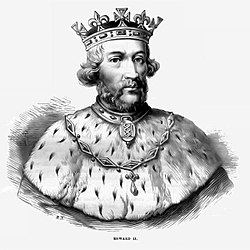
The Battle of Old Byland (also known as the Battle of Byland Abbey, the Battle of Byland Moor and the Battle of Scotch Corner) was a significant encounter between Scots and English troops in Yorkshire in October 1322, forming part of the Wars of Scottish Independence. It was a victory for the Scots, the most significant since Bannockburn.

1.4 km
Stanbrook Abbey
Stanbrook Abbey is a Benedictine abbey in Wass, North Yorkshire, England. The Roman Catholic community was founded in 1625 at Cambrai in Flanders (then part of the Spanish Netherlands, now in France), under the auspices of the English Benedictine Congregation. After being imprisoned during the French Revolution, the surviving nuns fled to England and in 1838 settled at Stanbrook, Callow End, Worcestershire, where a new abbey was built. With the steep contemporary decline in monastic life, the community left their Grade II-listed property, to relocate to Wass in the North York Moors National Park in 2009. Following refurbishment, the former Worcestershire monastic estate has been operated as a luxury hotel since 2015.

1.6 km
Mount Snever Observatory
Mount Snever Observatory is a historic building in Oldstead, a village in North Yorkshire, in England.
The observation tower was constructed in 1838, in part to commemorate the Coronation of Queen Victoria. It was commissioned by John Wormald, and built by J. Dodds atop the Snever Point hill. While digging foundations for the building, a human skeleton was discovered. Wormald died in 1848, and later in the century the building was opened to the public, although it fell into decay. It was restored in the late 20th century by Noel Appleby, and again in about 2000, but is disused and kept locked. Gwyn Headley describes the building as "rather austere". The building was grade II listed in 1986.
The observatory is housed in a square limestone tower about 35 feet (11 m) in height, with a platform on the front. The doorway has a massive stone lintel, it is flanked by buttresses, and over it is an inscription. Above is a three-light fixed window, a wooden parapet, and coped angle turrets. There is another inscription on the rear.
The inscription on the front is adapted from Alexander Pope's poem "Windsor-Forest": "Here hills and waving groves a scene display And part admit and part exclude the day See rich industry smiling on the plains And peace and plenty tell VICTORIA reigns! Happy the MAN who to these shades retires Whom NATURE charms and whom the muse inspires Who wandering thoughtful in this silent wood Attends the duties of the wise and good To observe a mean, be to himself a friend To follow NATURE and regard his end".

1.9 km
Nude in the Nettles
The Nude in the Nettles is the name given by the media to the body of an unknown female found concealed under what was reportedly a nettle bush (actually a willowherb bush) near Sutton Bank in North Yorkshire, England in 1981. The police were notified of the body’s location by an anonymous caller who claimed that he could not give his name for reasons of “national security”. Neither the identity of the woman nor that of the caller has ever been established despite an extensive investigation.

2.0 km
Scawton
Scawton is a village and former civil parish in North Yorkshire, England. The hamlet lies just east of Sutton Bank, north of the A170 road, and 5 miles (8 km) west of Helmsley, in the Hambleton Hills. The wider parish was the setting for the Battle of Old Byland, on Scawton Moor to the south. The road through the village used to link the two abbeys at Byland and Rievaulx, with the church, and possibly the village pub, being instigated by the monks for the use of travellers. In 1961 the parish had a population of 84.