


Le district de Košice-okolie (littéralement « Košice-environs ») est l’un des 79 districts de Slovaquie, situé dans la région de Košice C’est le seul pour lequel les administrations se trouve en dehors du territoire du district, dans la ville de Košice, enclavée dans le district.
Gallery


Sponsored
Location
1 explorer visited this place
0 m
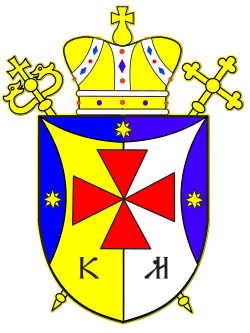
The Eparchy of Košice is an eparchy of the Slovak Greek Catholic Church that is situated in south-eastern Slovakia. Its episcopal seat is the Cathedral of the Nativity of the Mother of God in the city of Košice. The eparchy is a suffragan of the metropolitan Archeparchy of Prešov. As an Eastern Catholic church, it uses the Byzantine Rite in the Slovak, Hungarian and Church Slavonic languages.
0 m
Košice–okolie District is a district in the Košice Region of eastern Slovakia. It surrounds the city of Košice, which serves as the district seat although it does not belong to the district.

0 m
The Košice Self-governing Region or the Košice Higher Territorial Unit is one of Slovakia's eight "self-governing regions" whose territory is identical with that of the administrative Košice Region.
The establishing session of the first Council of the Košice Self-governing Region was held on December 19, 2001, in the historical hall of former Župný dom with the participation of 57 deputies elected in the first regional elections for the second level of self-government in Slovakia. Rudolf Bauer in 2001 was elected as the first president of the Košice Self-governing Region. His successor was Zdenko Trebuľa elected for the president of the Košice Self-governing Region on December 10, 2005. He was inaugurated on January 9, 2006.
His successor is the current president Rastislav Trnka, elected in 2017 at 33, is the youngest regional president. Trnka ran as an independent with the support of various centre-right parties, the KDH, SaS, OĽaNO, NOVA, and ŠANCA, defeating his opponent, Richard Raši.
The seat of the Košice Self-governing Region is a former military headquarters building on the eastern part of the Námestie Maratónu mieru in Košice. It was completed in 1908 as the largest and the most modern building in the town at that time.
0 m
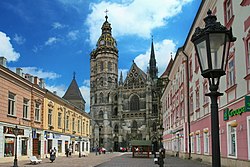
Košice is the largest city in eastern Slovakia. It is situated on the river Hornád at the eastern reaches of the Slovak Ore Mountains, near the border with Hungary and Ukraine. With a population of approximately 230,000, Košice is the second-largest city in Slovakia, after the capital Bratislava.
Being the economic and cultural centre of eastern Slovakia, Košice is the seat of the Košice Region and Košice Self-governing Region, it belongs to the Košice-Prešov agglomeration, and is home to the Slovak Constitutional Court, three universities, various dioceses, and many museums, galleries, and theatres. In 2013, Košice was the European Capital of Culture, together with Marseille, France. Košice is an important industrial centre of Slovakia, and the U. S. Steel Košice steel mill is the largest employer in the city. The town has extensive railway connections and an international airport.
The city has a preserved historical centre which is the largest among Slovak towns. There are heritage protected buildings in Gothic, Renaissance, Baroque, and Art Nouveau styles with Slovakia's largest church: the Cathedral of St. Elizabeth. The long main street, rimmed with aristocratic palaces, Catholic churches, and townsfolk's houses, is a thriving pedestrian zone with boutiques, cafés, and restaurants. The city is known as the first settlement in Europe to be granted its own coat of arms.
259 m
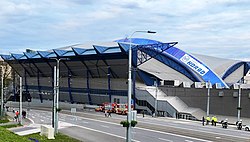
Steel Arena – Ladislav Troják Stadium in Košice is the home arena of the ice hockey club HC Košice. Its capacity is 8,343.
The arena opened on February 24, 2006, and was named in honor of the general sponsor of the club, U. S. Steel Košice and also in honor of Ladislav Troják, a Košice-born hockey player who was the first Slovak to win the World Championship with the Czechoslovakia national team.