


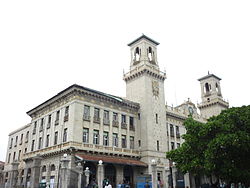
La gare de La Havane-Centrale (en espagnol : Estación Central de Ferrocarriles) est la gare ferroviaire principale de la ville de La Havane, à Cuba. Elle est exploitée par la compagnie nationale des Ferrocarriles de Cuba. La gare est fréquentée chaque année par près de douze millions de voyageurs.
Book your tour near
Gare de La Havane-Centrale
Book Now
4.3
in partnership with
GetYourGuide.com
Gallery


Sponsored
Location
1 explorer visited this place
0 m
Havana Central is the main railway terminal in Havana and the largest railway station in Cuba. It serves as the hub of the rail system in the country. It handles the arrival and departure of national and divisional commuter trains, and is home to the national railway company, Ferrocarriles Nacionales de Cuba, the only intercity passenger rail transport operating in the Caribbean.
The building is considered a national monument for its architectural and historical values and is, along with the stations of Santiago, Camagüey and Santa Clara, a network's divisional headquarter.
349 m
The Archivo Nacional de la República de Cuba is the national archive of Cuba. Founded in 1840, it is located in Havana on Calle Compostela. Directors have included Vidal Morales y Morales and Joaquín Llaverías Martínez.

401 m
The Arco de Belén is a historic arch in Havana, Cuba. It was built by master builder Pedro de Medina between 1772 and 1775, as an addition to connect the convent and church of Nuestra Señora de Belén located on Calle Acosta, which was originally constructed between 1718 and 1720.
The Belen Jesuit Preparatory School was located in the convent from the mid 19th century until they relocated to Marianao in 1925. After the Jesuit school vacated the convent, the building became state-owned. In 1988, the Cuban Academy of Sciences was based in the convent, while the rest of the building was abandoned. The Arco de Belén underwent significant restoration efforts alongside the convent in the 1980s.

509 m
Fuente de la India is a fountain by Giuseppe Gaggini in Havana, Cuba, at the south extreme of Paseo del Prado, about 100 m south of El Capitolio, between Monte and Dragones Streets. The figure represents the Indian woman "Habana" in whose honor Havana was named.
Originally it was placed outside the city walls at the end of the Alameda which today is the Paseo del Prado. From 1803 until that time a statue of King Carlos III was located there. Its opening was an event in the then still young town of San Cristobal. In 1863, by the resolution of Council, the fountain was moved to the Parque Central. In 1875 it was put back in its current position, i.e. its initial one but facing towards the then called Campo de Marte. In 1928, when the adjacent area became the Plaza de la Fraternidad, the statue was rotated 90° to face the new Capitolio building.

521 m
The Hotel Saratoga was a historic hotel located on the Paseo del Prado, in Old Havana near the Fuente de la India. Built in 1880 as a warehouse, it was remodeled into a hotel in 1933. It was further remodeled in 2005 and reopened as a luxury hotel. The hotel was largely destroyed by a gas explosion on 6 May 2022, which killed forty-seven people.