

 English
 Français

Church of St Oswald, Thornton Steward
The Church of St Oswald, Thornton Steward is an Anglican church to the west of the village of Thornton Steward in North Yorkshire, England. St Oswald's is thought to be one of the oldest churches in Wensleydale. It was mentioned in the Domesday Book, and has Norman origins. The building is located in a burial plot dating back as far as the 7th century, and is now a grade II* listed structure.
Nearby Places View Menu

852 m
Thornton Steward
Thornton Steward is a small village and civil parish in North Yorkshire, England, near Wensleydale, with a population of 100–200, measured at 199 in the 2011 Census. The name derives from Old English relating to a hawthorn tree on a farm (or settlement) and Steward. The village was formerly owned by Wymar, who was the steward of the Earls of Richmond. The village is very similar to the others that dot Wensleydale, but Thornton Steward has a reservoir owned by Yorkshire Water.
From 1974 to 2023 it was part of the district of Richmondshire, it is now administered by the unitary North Yorkshire Council.
The village includes the ancient St Oswald's Church, which is reputedly the oldest church in Wensleydale with some parts being dated back to the year 680. The church was subject to Channel 4's show Time Team, where they found remains of a communion of monks. The village was also featured in the British television series All Creatures Great and Small, in the episode "If Wishes Were Horses".
The hill, East Witton fell, is visible from Thornton Steward and on the western side Jervaulx Abbey is visible.
The school house was founded in 1815 by George Horn, with a budget of '£10 per annum', but was closed during the 20th century. It is situated in between the towns of Leyburn and Bedale, and is near to several tourist attractions such as Thorp Perrow Arboretum and the Green Howards regimental exhibition.

1.1 km
Jervaulx Hall
Jervaulx Hall is a historic building in East Witton, a village in North Yorkshire, in England.
The house was built in the early 19th century, and it long belonged to the Christie family. It is known for its eight-acre gardens, laid out in the 1800s, incorporating part of the grounds of Jervaulx Abbey, and restored in the 2010s. They include remains of the abbey's corn drying kiln, a Victorian summerhouse, and a range of contemporary sculpture. The building served as a hotel in the late 20th century. The building was grade II listed in 1985. It was put up for sale in 2005 for £1.55 million, at which time it had four reception rooms, eight bedrooms, and seven bathrooms.
The house is built of is stone with a stone slate roof. It has two storeys and a symmetrical front of six bays. The middle two bays are recessed, and have a lead roofed loggia over medieval tile paving, and a doorway. These are flanked by bays with canted bay windows, and Dutch gables with coping and ball finials, and the outer bays have coped gables with ball finials.
The building has a grade II listed gatehouse, built of stone with a stone slate roof. In the centre is a semicircular arch with corniced capitals and a faceted keystone. This is flanked by lodges with shell niches, and the parapet has finials and semicircles. Within the archway, the doorways of the lodges have chamfered surrounds and four-centred arched heads. At the rear of the lodges are three-light mullioned windows.
1.2 km
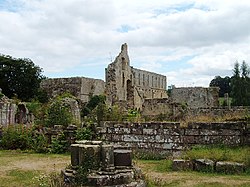
Jervaulx Abbey
Jervaulx Abbey in East Witton in North Yorkshire, 14 mi (23 km) north-west of the city of Ripon, was one of the great Cistercian abbeys of Yorkshire, England, dedicated to St Mary in 1156. It is a Grade I listed building.
The place name Jervaulx is first attested in 1145, where it appears as Jorvalle. The name is French for 'the Ure valley' and is perhaps a translation of the English 'Ure-dale', also known as Yoredale. The valley is now called Wensleydale.

1.6 km
Thornton Steward Reservoir
Thornton Steward Reservoir is a reservoir north of the village of Thornton Steward in North Yorkshire, England. It is owned by Yorkshire Water, and supplies drinking water to Swaledale, Wensleydale, Northallerton, and Thirsk.
Thornton Steward Water Treatment Works (WTW) opened in 1977, and was refurbished in the 1990s. It was upgraded in 2003, and its mains connections improved in 2007, allowing Yorkshire Water to close older works in Langthwaite and at Cod Beck Reservoir above Osmotherley. The removal of the Langthwaite WTW, which was fed with groundwater from an adit, means that Thornton Steward now meets the needs of the Swaledale settlements formerly provided by Langthwaite.
The majority of the water from Thornton Steward is piped to a pumping station north of Ainderby Steeple and from there to Bullamoor Reservoir (a system of four covered concrete cisterns on the hillside east of Northallerton). That in turn supplies Northallerton and Thirsk.
The reservoir is fed from water pumped from the River Ure, which is extracted at Kilgram Bridge 1 mile (2 km) to the south. It is also supplied with water from Leighton Reservoir.
The reservoir is host to the Thornton Steward Sailing Club and is used for fly fishing.