


Novotcherkasskaïa (en russe : Новочерка́сская) est une station de la ligne 4 du Métro de Saint-Pétersbourg. Elle est située dans le raïon Krasnogvardeïski à Saint-Pétersbourg en Russie. Mise en service en 1985, elle est desservie par les rames de la ligne 4 du métro de Saint-Pétersbourg.
Gallery


Sponsored
Location
1 explorer visited this place
6 m
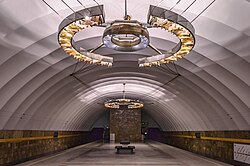
Novocherkasskaya is a station on the Line 4 of Saint Petersburg Metro, opened on December 30, 1985. The station was planned to be named Zanevskaya, but it was ultimately called Krasnogvardeyskaya until 1992; the station's name was changed after its namesake, the Krasnogvardeysky Avenue, was renamed to Novocherkassky. The station is unique as it does not have its own building above ground; one must enter through an underground pedestrian crossing.

650 m
The Higher Special Officer Classes of the Navy, formally the Higher Special Officer Order of Lenin Classes of the Navy, and known by its abbreviation VSOK VMF is a higher naval education institution in Saint Petersburg which educates serving officers of the Russian Navy in specialisations for more senior ranks and positions.
Since 2012 its official name has been Military Institute of the Military Scientific Center of the Navy "Naval Academy" ВУНЦ ВМФ «Военно-морская академия»).

802 m
The Okkervil is a river in Leningrad Oblast and the eastern part of the city of Saint Petersburg, Russia. It is the largest left tributary of the Okhta. It is 18 kilometres long and 1.5 to 25 metres wide.
The name Okkervil appeared in the 17th century, after the Swedish colonel who owned an estate on the bank. On some ancient maps of Saint Petersburg, the river is called Little Okhta as opposed to Big Okhta. Yet other times it is called Porkhovka.
"Okkervil River" is the title of a well-known short story by Tatyana Tolstaya. The Austin, Texas-based indie rock band named Okkervil River takes its name from the story.

877 m
Utkina Dacha is an 18th-century architectural ensemble in St. Petersburg, at the junction of the Okkervil and the Okhta rivers. It is included in Russian cultural heritage register under number 7810250000. As of 2019 the neglected building is a branch of a museum.
Prior to the founding of St. Petersburg this land near the Nyenschantz fortress was owned by Swedish colonel Okkervil. Later the chief of the Secret Chancellery general Andrey Ushakov became an owner. In the middle of the 18th century this land was granted to Agafokleya Poltoratskaya and her husband Mark Poltoratsky as an award for their involvement in opera productions.
The Manor of Okkervil was managed by their daughter Agafokleya Sukhareva, who also owned the neighboring site upstream the river Okhta. One of their daughters, Elizabeth, became the wife of Alexey Olenin, the future president of the Imperial Academy of Arts. Alexander Pushkin fell in love with another their daughter, Anna Olenina, granddaughter of Poltoratsky. Pushkin asked for her hand in the summer of 1828, but was turned down.
There is a speculation that the designer of the manor was the famous architect Nikolay Lvov. In the 1820–1830s a service building was erected.
After the 1917 Russian Revolution, the estate passed to the Commissariat of Health, and housed Malookhtinsky office of the 2nd psychiatric hospital. In the late 1930s, parts of the buildings were re-planned for residential apartments, while other premises were used by various institutions.

1.0 km
The Alexander Nevsky Bridge in St Petersburg, Russia is named after the legendary Russian military commander and politician Alexander Nevsky. The bridge connects Alexander Nevsky Square and Zanevsky prospect thus linking the southern and the northern parts of the city. Until 2004, when the Big Obukhovsky Bridge was built, the Alexander Nevsky Bridge was the longest bridge across the Neva River in Saint Petersburg. Its length is 906 meters, and it is 35 meters wide.
The bridge was built from 1960 to 1965 under the working name of Old Neva Bridge.
Designed by the group of architects A. Zhuk, S. Mayofis and Y. Sinitsa, the bridge has complemented the look of adjacent buildings in the surrounding area. The project was led by a team of engineers of the "Lengiprotransmost" institute. Proof-testing was done by means of a column of army tanks. On November 5, 1965, the bridge was open for traffic.