Location Image

Blairgowrie High School

Blairgowrie High School is a high school in Blairgowrie, Scotland. Blairgowrie High School has 916 students from Blairgowrie and the surrounding area. The current head teacher is Paul Cunningham.

Nearby Places View Menu
Location Image
260 m

Blairgowrie Community Hospital

Blairgowrie Community Hospital is a health facility in Perth Road, Blairgowrie and Rattray, Scotland. It is managed by NHS Tayside.
Location Image
806 m

Blairgowrie railway station

Blairgowrie railway station served the burgh of Blairgowrie and Rattray, Perth and Kinross, Scotland from 1855 to 1955 on the Scottish Midland Junction Railway.
Location Image
854 m

Blairgowrie and Rattray

Blairgowrie and Rattray ( ) is a twin burgh in Perth and Kinross, Scotland. Locals refer to the town as "Blair". Blairgowrie is the larger of the two former burghs which were united by an Act of Parliament in 1928 and lies on the southwest side of the River Ericht while Rattray is on the northeast side. Rattray claims to be the older and certainly Old Rattray, the area round Rattray Kirk, dates back to the 12th century. New Rattray, the area along the Boat Brae and Balmoral Road dates from 1777 when the River was spanned by the Brig o' Blair. The town lies on the north side of Strathmore at the foot of the Grampian Mountains. The west boundary is formed by the Knockie, a round grassy hill, and Craighall Gorge on the Ericht. Blairgowrie and Rattray developed over the centuries at the crossroads of several historic routes with links from the town to Perth, Coupar Angus, Alyth and Braemar. The roads to Coupar Angus and Braemar form part of General Wade's military road from Perth to Braemar then onto Fort George. The town's centrepiece is the Wellmeadow, a grassy triangle in the middle of town which hosts regular markets and outdoor entertainment.
Location Image
972 m

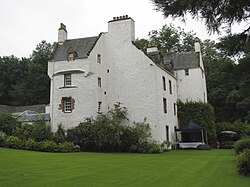
Newton Castle

Newton Castle, a Category A listed building dating to the mid-16th century, stands near the town of Blairgowrie in Perth and Kinross, Scotland. It had minor alterations in the 18th century, and in 1883 a wing was added to the northwest, possibly by Lake Falconer. A subterranean vault, possibly discovered in 1911, is listed separately.