Location Image

Hillhead Baptist Church

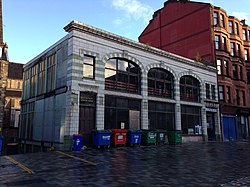
Hillhead Baptist Church is a Baptist church in the west end of Glasgow, Scotland. It is affiliated with the Baptist Union of Scotland. It has operated for over 125 years, one of 164 active Baptist churches in Scotland in the early twenty-first century. External features of the church building include prominent Greek columns, casement windows, and a triple-doorway front access, with doors, by tradition, painted sky blue. Internal features include a columned gallery and two levels of seating. It was designed by Thomas Lennox Watson (1850–1920), of Glasgow, the sixth of a dozen churches built to Lennox Watson design during the era. Historic Scotland designated Hillhead Baptist Church a Category B preserved building in 1970 (building number LB32860).

Nearby Places View Menu
Location Image
65 m

Hillhead subway station

Hillhead subway station is a station on the Glasgow Subway, serving the Hillhead area of Glasgow, Scotland, and is the principal station that serves the city's West End. The entrance is located on Byres Road. This station is the nearest to Glasgow Botanic Gardens and the University of Glasgow. The station is one of the busiest on the system with 1.86 million boardings per year. This is largely due to the shopping facilities of Byres Road and proximity to the university, which allows students to travel between campus and the city centre.
Location Image
83 m

Western Baths

The Western Baths Club "the Baths" is a Victorian-era private swimming and leisure club founded in 1876. The Club remains at its original site at 12 Cranworth Street, Hillhead, Glasgow. The 19th-century Baths, designed by Glasgow Architects Clarke & Bell are protected as a "Category A listed building", within a designated conservation area and along with the Arlington Baths Club, it is one of two Victorian Pools of its kind left in Glasgow. Some years ago the Club acquired adjacent ground to the West and erected a new building to house a modern Sports Hall and Gym thereby further extending and enhancing the Club's facilities. The Baths are distinctive for their period trapeze and exercise rings over the swimming pool, and its Victorian Turkish bath is one of only three remaining in Scotland. The Baths are also a founding and current member of the Historic Pools of Britain, being one of eleven Victorian Pools remaining in the UK. The 'Baths' as they are more commonly known have survived mixed fortunes over their lengthy existence having at one point closed and lay almost derelict however was successfully reopened. A similar fate nearly closed the Baths in the 1970s "the day the roof fell in". The Victorian slated roof over the swimming pool partially collapsed and with the Cochrane oil-fired boiler rarely working the Club was trading at a loss and the membership dwindling. The then Secretary William M. Mann CBE worked to secure funding support to ensure the Club's survival. The position of Bathsmaster was simply the role of Manager in Victorian times but the title referred to those of Victorian swimming pools/clubs. In its long life, there were five post-holders, Campbell, Jamieson, Wilson, McKellar, and Anderson. The Baths continue to have a Manager, but the term has changed to General Manager (a title previously held by Mr Campbell, who was promoted to General Manager (and for a brief period in the 1980s Mr McKellar) who had overall control of all aspects of the club. The current position of General Manager within the Club is occupied by Ms Kathleen McCurry who stepped up from the position of Depute General Manager in March 2022 In 2026, The Western Baths Club will celebrate the 150th year anniversary of its founding. Changed days since Alison F Blood wrote in her 1929 book Kelvinside Days that there were other baths in Glasgow, but the Western Baths were simply known as 'the Baths' and no one would have thought otherwise.
Location Image
146 m

Curlers Rest

The Curlers Rest, formerly the Curlers Tavern, is the oldest drinking establishment on Byres Road, Glasgow, Scotland. A tavern is said to have been situated at this site since the 17th century, when this part of the city was still countryside. The rural connection is today only remembered in the name Byres Road, from the lands known as the Byres of Partick. The present pub is housed in an 18th-century two-story cottage-type building and derives its name from the large pond, which could be found nearby. Every winter curlers came to play on the ice. Furthermore, the Partick Curling Club (established in 1842) had its pond here in 1848. There is also a legend associated with the pub which claims that King Charles II came riding one cold winter’s day towards Glasgow on what was then a lonely highway and "spotting the inviting hostelry called a halt for refreshments. Finding it shuttered and barred, the landlord was quickly rousted out and told to open up in the name of the King which he did with the satisfaction that "the Merry Monarch bestowed upon the inn the right, by Royal Charter, to be open day and night, Sundays included, in perpetuity". At the front of the building there are three doors. In the past there were three bars here, the door on the left leading through the lounge bar, the door on the right to the small snug, and the door in the middle leading upstairs to the hall space/banqueting area above. From 1999 till June 2010 the pub was a Scream pub geared firmly towards students. It was then refurbished and rebranded as the Curler's Rest.
Location Image
154 m

Botanic Gardens Garage

The Botanic Gardens Garage is a two-story, five-bay Category A-listed building in the West End of Glasgow, Scotland. It is located on Vinicombe Street, a one-minute-walk from the Glasgow Botanic Gardens. It is the oldest surviving purpose-built motor garage in Glasgow. The building is no longer used as a garage, and instead houses restaurants and a gym.