


Sitges contre l'homophobie (en catalan : Sitges contra la homofobia) est un monument dédié à l'histoire des persécutions contre les lesbiennes et les homosexuels situé dans la ville de Sitges, en Catalogne.
Location
678 m
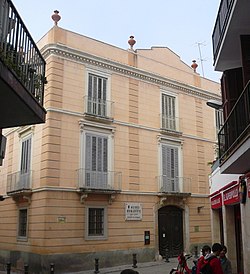
The Can Llopis Romanticism Museum is a museum located in Neoclassical-style building in the centre of Sitges and is part of the Barcelona Provincial Council Local Museum Network.

923 m
The Maricel Museum is a museum located in the centre of Sitges; reopened after a major refurbishment in 2015.
The Maricel Museum is part of the Barcelona Provincial Council Local Museum Network.

944 m
Cau Ferrat, located in Sitges, was the home and study of artist and writer Santiago Rusiñol, one of the most important figures of the Modernisme movement in Catalonia. It is one of the three museums in Sitges located on the shores of Sant Sebastià beach.

958 m
Sitges is a Rodalies de Catalunya railway station serving Sitges, in Catalonia, Spain. It is served by Barcelona commuter rail service line R2 Sud as well as some trains on regional lines R13, R14 and R15.
The station has three platforms: platform 2 is the location of the main ticket office and waiting room as well as the entrance and exit to the station. Platforms 1 and 3 form an island platform which are accessed by an underground subway from platform 2, or from an underground entrance from the other side.
Unfortunately, disabled access to platforms 1 and 3 is very problematical, as the elevators are frequently out of service. This in turn creates a problem for those arriving from the Barcelona direction as the only way to descend from the platform is by stairs or the troublesome elevators. When the elevators are out of action, as is frequently the case, a wheelchair user has to travel to the next station, Vilanova i la Geltrú, then return to Sitges to be able to exit the station via platform 2.
Coming from Barcelona the preceding station is Garraf and the following station is Vilanova i la Geltrú.

1.8 km
Sitges is a town about 35 kilometres southwest of Barcelona, in Catalonia, Spain, renowned worldwide for its film festival, Carnival. Located between the Garraf Massif and the Mediterranean Sea, it is known for its beaches, nightspots, and historical sites.
While the roots of Sitges' artistic reputation date back to the late 19th century, when painter Santiago Rusiñol took up residence there during the summer, the town became a centre for the 1960s counterculture in mainland Spain during the Francoist regime, and became known as "Ibiza in miniature".
Today, the economy of Sitges is based on tourism and culture, offering more than 4,500 hotel beds, half of them in four-star hotels.
Almost 35% of the approximately 26,000 permanent inhabitants are from the Netherlands, the UK, France, and Scandinavia, whose children attend international schools in the area. There are 17 beaches. Sitges was also the site of the annual Bilderberg conference held in June 2010.
Sitges has been referred to as the Saint-Tropez of Spain, with property prices approaching those of the most expensive European cities, the main reason for this being the setting by the sea and the surrounding Garraf Park. Proximity to Barcelona-El Prat Airport is also a major advantage.