


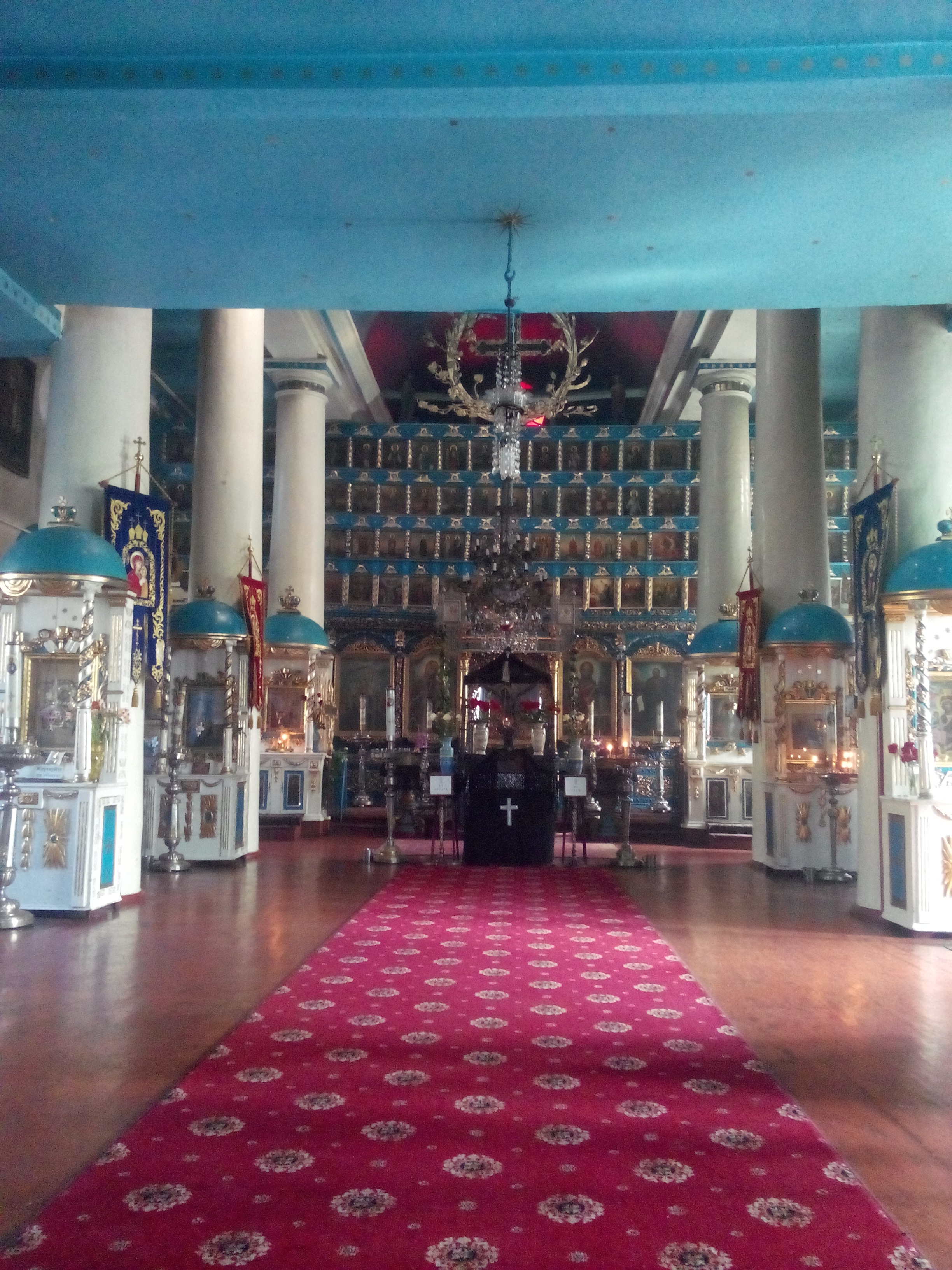
L'église de la Nativité-de-la-Vierge, en ukrainien Греко-Софійська церква (Херсон), est une église située au cœur de la ville de Kherson située en Ukraine. L'église, dédiée à la Nativité de la Vierge porte aussi le nom de église Greco-Sophia, église Saint-Noël-Theotokos, de la Nativité de la Très Sainte Théotokos. Elle fait suite à d'autre église de la Nativité, celle-ci fut bâtie par la volonté de Ivan Hannibal.
Gallery




Sponsored
Location
1 explorer visited this place
329 m
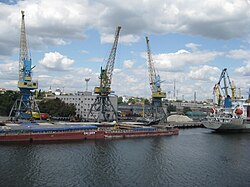
The Seaport of Kherson is in the city of Kherson, Ukraine, in the delta of the Dnieper river.
The berthing line of the seaport is 1.5 km, with depths up to 9.6 m. The port is served by the railway station Kherson-Port, has one railway entry. There are 7 railway tracks in the port area with a total length of 3.2 km. The highways are adjacent to the port.
The cargo turnover of Kherson seaport in 2016 amounted to 3.7 million tons. The capacity of terminals of Kherson seaport reaches 8.0 million tons / year.

434 m
The Kherson Local History Museum is a cultural institution and museum that was created in 1963 following the merging of the Kherson Historico-Archeological Museum and the Kherson Natural Historical Museum. The Historico-Archeological Museum was founded in 1890 and the Natural Historical Museum was founded in 1899. The museum has a branch in Kakhovka.
The museum has information and items regarding the history of Kherson Oblast, including its natural history and history after the Ukrainian War of Independence, which began in 1917.
The museum's collection included, prior to the Russian invasion, anthropomorphic steles of the pit culture from 2nd millennium BC, mace tops of the catacomb culture, ancient Greek amphoras from the late-Scythian period, a Scythian ritual headdress, a golden Sarmathian earring, a Polovtsian stone woman statue and an early medieval chandelier.
519 m
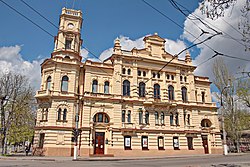
The Kherson Art Museum is an art museum in Kherson, Ukraine. It is housed in Kherson's former city hall building. The museum opened on 27 May 1978.
During the 2022 Russian invasion of Ukraine, the museum was looted by Russian troops while Kherson was occupied. A short time before the city was liberated by Ukrainian forces, the collection was moved to the Central Museum of Taurida in Simferopol in Russian-occupied Crimea.

630 m
Kherson River Port is a large transport hub in Kherson where river, sea, rail and road transport interconnect. It is on the left bank of the Koshevaya or Koshova river, leading up to where it enters the Dnieper river. It has seven ship berths along 950 metres of dock.
Kherson River Port formed at the same time as Kherson town. The first shipment was received from the upper reaches of the Dnieper for those who were building Kherson fortress and the shipyard. In 1946 the Kherson river pier received its status of Kherson River Port. In the Soviet era, 9 to 11 million local and tourist passengers a year passed through the port; by 2016 the number had dropped to 1.2 million. In 1975–1985 the port handled up to 1.5 million tons of sand a year, but the sand quarrying had stopped by 2016. Since the 1980s it has handled bulk and general cargo, including rolled ferrous metal, timber, bauxite, scrap metal, coal, coke and mineral fertilizers. It was handling 33,000–35,000 tons a month, as of 2016.

755 m
The Battle of Khresili was fought on December 14, 1757, between the armies of the Kingdom of Imereti and the Ottoman Empire. King Solomon I of Imereti established a strong monarchy and unified western Georgia. His actions strained the relations between him and the Ottoman Empire. The Ottomans, in particular, sought to stop Solomon's struggle against slavery. They were in an alliance with rebellious Georgian nobles who opposed their monarch. One of them was Levan Abashidze, who led an Ottoman army to the Kingdom of Imereti. Solomon enticed his enemies into a strategically adroit place near Khresili where his forces would gather to engage them.
EN 1778 une église en bois fut érigée puis remplacée par une en briques à partir de 1780.