


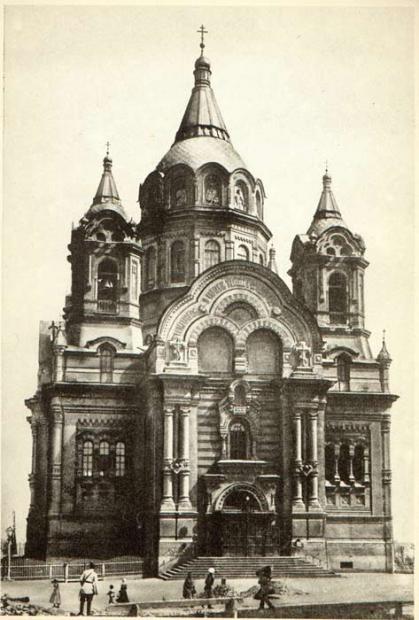
L'église des Saints-Boris-et-Gleb (église Borisoglebskaya) est une ancienne église orthodoxe de Saint-Pétersbourg, un monument architectural. Construite en 1866-1882, elle a été détruite à l'époque soviétique en 1975.
Gallery

Sponsored
Location

711 m
The Alexander Nevsky Bridge in St Petersburg, Russia is named after the legendary Russian military commander and politician Alexander Nevsky. The bridge connects Alexander Nevsky Square and Zanevsky prospect thus linking the southern and the northern parts of the city. Until 2004, when the Big Obukhovsky Bridge was built, the Alexander Nevsky Bridge was the longest bridge across the Neva River in Saint Petersburg. Its length is 906 meters, and it is 35 meters wide.
The bridge was built from 1960 to 1965 under the working name of Old Neva Bridge.
Designed by the group of architects A. Zhuk, S. Mayofis and Y. Sinitsa, the bridge has complemented the look of adjacent buildings in the surrounding area. The project was led by a team of engineers of the "Lengiprotransmost" institute. Proof-testing was done by means of a column of army tanks. On November 5, 1965, the bridge was open for traffic.

727 m
The Higher Special Officer Classes of the Navy, formally the Higher Special Officer Order of Lenin Classes of the Navy, and known by its abbreviation VSOK VMF is a higher naval education institution in Saint Petersburg which educates serving officers of the Russian Navy in specialisations for more senior ranks and positions.
Since 2012 its official name has been Military Institute of the Military Scientific Center of the Navy "Naval Academy" ВУНЦ ВМФ «Военно-морская академия»).

794 m
Ploshchad Alexandra Nevskogo I is a station on the Nevsko–Vasileostrovskaya Line of Saint Petersburg Metro, opened on 3 November 1967.

871 m
Alexander Nevsky Square, formerly called Red Square, is a city square in Tsentralny District, Saint Petersburg. At the east end of Nevsky Prospekt, linking the street with the Alexander Nevsky Lavra, it is named after medieval Russian Prince Alexander Nevsky.
Designed as part of the development of the monastery in the late 18th century, the square had received its name by at least 1784, and was laid out in the 1790s with the building of the Gate Church, and the establishment of a stone wall boundary. Several apartment buildings and an almshouse owned by the monastery were built fronting the square and Nevsky Prospekt. The alternative name Alexander Nevsky Lavra Square entered usage in the mid-19th century. By the early 20th century the square was considerably neglected and rundown. It was considered unsafe to walk through at night due to the likelihood of being robbed, while urban legends about voracious rats circulated. It was renamed Red Square in the early Soviet period, but reverted to Alexander Nevsky Square in 1952.
The area was redeveloped in the 1960s with the completion of the Alexander Nevsky Bridge, and the opening of the Hotel Moscow and the metro station Ploshchad Alexandra Nevskogo. Another metro station, Ploshchad Alexandra Nevskogo-2, opened in the 1980s and in 2002 long-held plans for a monument to Alexander Nevsky came to fruition with the installation of a bronze equestrian sculpture in the square.

901 m
Ploshchad Alexandra Nevskogo II is a station on the Line 4 of Saint Petersburg Metro, opened on December 30, 1985.