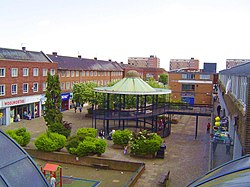
Tees Valley is a combined authority area in North East England, around the lower River Tees. The area is not a geographical valley. The combined authority covers five council areas: Darlington, Hartlepool, Middlesbrough, Redcar and Cleveland and Stockton-on-Tees: this includes areas in both County Durham and North Yorkshire counties. The town of Middlesbrough is the largest population centre in the area. The borough of Middlesbrough is the smallest of the five, at only 54 square kilometres (21 sq mi) and a population of 156,161: the Stockton-on-Tees borough (including multiple towns) is the largest with an area of 205 square kilometres (79 sq mi) and a population of 206,800, as of 2024. From 1968 until 1974, parts of the area were included in the County Borough of Teesside council area. This was replaced by Cleveland county; it had four borough councils which became unitary authorities after the county was abolished in 1996. Darlington became a unitary authority in 1997; the five authorities formed a Local Enterprise Partnership in 2011, further collaboration between the five authorities lead to Tees Valley Combined Authority being created in 2016.

Nearby Places View Menu
Location Image
869 m

Haverton Hill

Haverton Hill is an area within the borough of Stockton-on-Tees and ceremonial county of County Durham, England. Once considered a part of Billingham, Haverton Hill was once a thriving industrial community which has suffered significant depopulation since the 1960s as a result of pollution. It is situated to the north of the River Tees, near Billingham. The A1046 is the main road linking to Stockton and the A19 in the west and Port Clarence and the A178 in the east.
Location Image
1.0 km

Billingham

Billingham is a town and civil parish in County Durham, England. The town is on the north side of the River Tees and is governed as part of the Borough of Stockton-on-Tees unitary authority. It had a population of 33,927, in the 2021 census. The settlement has existed since Anglo-Saxon times as a village. A post-Second World War town centre was built north of the old village centre on the town's grange. It was a township, with an urban district, from 1923, until 1968, when it was absorbed into the County Borough of Teesside, and later part of the county of Cleveland. Billingham is home to the Billingham Manufacturing Plant which is a major producer of chemicals for agriculture.
Location Image
1.0 km

Cowpen Bewley

Cowpen Bewley is a village and former civil parish, now in the parish of Billingham, in the Stockton-on-Tees district, in the ceremonial county of Durham, England. In 1931 the parish had a population of 706.
Location Image
1.0 km

Teesside EfW

Teesside Energy from Waste plant (also known as Teesside WTE power station or Haverton Hill incinerator) is a municipal waste incinerator and waste-to-energy power station, which provides 29.2 megawatts (MW) of electricity for the National Grid by burning 390,000 tonnes of household and commercial waste a year. It is located on the River Tees at Haverton Hill, east of Billingham in North East England. Developed and built by NEM, a subsidiary of Northumbrian Water, the initial plant replaced the Portrack Incinerator and opened in 1998. Subsequently, the facility became part of SITA, now Suez. The station is one of the most modern incinerators operating in England; it is noted for its innovative operation. In 2009, an extension was completed at the station, with the construction of an extra furnace line and a rail head. This increased the capacities of the plant from 19.2 MW and 250,000 tonnes of waste per year to its current levels. The plant initially received waste from Teesside and North Tyneside, but this was extended to include Northumberland with the 2009 extension. A second plant, the North East Energy Recovery Centre (NEERC), has been built on land adjacent to the first plant. This extends the site's catchment to include waste from south Tyne and Wear.