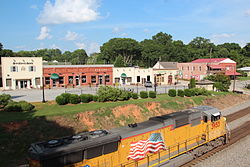
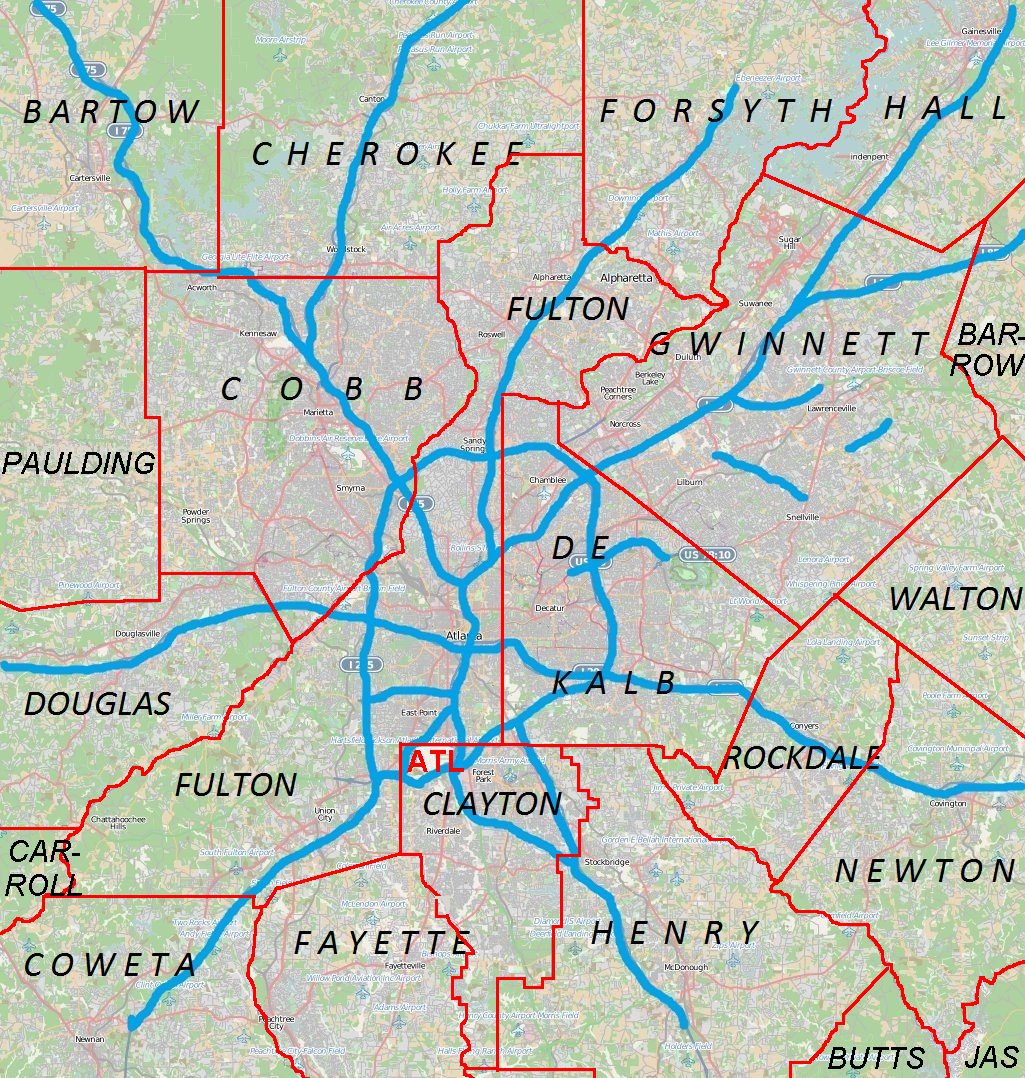
Hiram (/Hai:rm/) is a city in Paulding County, Georgia, United States. It is approximately part of Metro Atlanta. As of the 2020 census, the population is 4,929. It is east of the County seat of Dallas
Gallery


Sponsored
Location
1 explorer visited this place

1.3 km
Hiram High School is a public high school in Hiram, Georgia, United States.
2.2 km
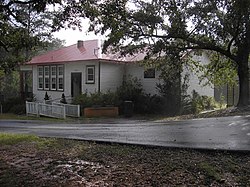
The Hiram Colored School in Hiram in Paulding County, Georgia was built in 1930. It was listed on the National Register of Historic Places in 2001. The school is located west of Georgia State Route 92 between its junctions with Fitzgerald Street and Alexander Street.
It is a two-room Rosenwald school, built with funding from Julius Rosenwald, President of Sears, Roebuck and Company. The Rosenwald Fund was established in 1912 to build schools for African-American students in Southern rural areas. Though nearly 5000 schools were built using the Rosenwald Fund, the Hiram Colored School was the only Rosenwald school in Paulding County. It was also the only African-American school in the county with a library. Today, its historical significance is preserved by the Hiram Rosenwald School Preservation Committee.

5.0 km
The Paulding County School District is a public school district in Paulding County, Georgia, United States, based in Dallas.
Its boundaries parallel that of the county. It serves the communities of Braswell, Dallas, and Hiram.

6.5 km
The Fannin-Cooper Farm, near Hiram in Paulding County, Georgia, was listed on the National Register of Historic Places in 2012. It is spread across both sides of Smith Road, including parcels at 620 and 511 Smith Rd., and is located about 7 miles east of Paulding County seat Dallas, Georgia.
Its main farmhouse, built in 1887, is a one-story, central hall plan house with a shed-roof front porch.

7.2 km
The Battle of Dallas was an engagement during the Atlanta campaign in the American Civil War. The Union army of William Tecumseh Sherman and the Confederate army led by Joseph E. Johnston fought a series of battles between May 25 and June 3 along a front stretching northeast from Dallas toward Acworth, Georgia. At Dallas a probe launched by William B. Bate's and William Hicks Jackson's Confederate divisions accidentally turned into a full-scale assault against the defenses of John A. Logan's XV Corps. The attack was driven off with heavy Confederate losses. The previous Union defeats at New Hope Church and the Pickett's Mill are sometimes considered with Dallas as part of one battle.
On May 23, Sherman moved away from his railroad supply line when he launched a wide sweep that aimed to turn Johnston's left flank. Johnston adroitly shifted his army toward Dallas to block Sherman's maneuver. The result was ten days of close fighting that resulted in more Union than Confederate casualties. After the Dallas battle, Sherman shifted his army to the northeast, looking for a way to turn the right flank of Johnston's entrenched defenses. On June 1, Union forces occupied Allatoona Pass on the Western and Atlantic Railroad line. This allowed the railroad to be repaired as far as that location and promised that future supplies could reach Sherman's army by train. On June 3, Union troops arrived at a flanking position that convinced Johnston to abandon his lines and fall back to another entrenched position that covered Marietta.