


La gare de Maury est une gare ferroviaire française de la ligne de Carcassonne à Rivesaltes, située sur le territoire de la commune de Maury, dans le département des Pyrénées-Orientales, en région Occitanie. Elle est mise en service en 1901 par la Compagnie des chemins de fer du Midi et du Canal latéral à la Garonne.
Location

676 m
Maury is a commune in the Pyrénées-Orientales department in southern France.

679 m
Maury is an Appellation d'Origine Contrôlée for fortified vin doux naturel wines made in the Roussillon wine region of France. Almost all wines are red, made from at least 75% Grenache noir. Other permitted grapes are Grenache blanc, Grenache gris, Macabeu, Malvoisie du Roussillon, Syrah, Muscat and other local varieties. Although the grapes are different, they are used and marketed very much like port. It is made in the communes of Maury, Saint-Paul-de-Fenouillet, Lesquerde, Tautavel and Rasiguères. The AOC was granted in 1936.
Maury is a "vin doux naturel" style created by adding fortifying spirits, such as brandy, to the wine in mid-fermentation. This halts the activities of the wine yeast leaving the wine with "natural" residual sugars. Maury is vinified in a manner similar to port, but initial aging is often conducted in large 25 liter glass jugs known as bonbonnes, les dames jeannes or demi-johns. The wines may also be aged in wood for up to 15 years. The resulting wines vary in depth and concentration.
In food and wine pairings, Maury is often served as an apéritif or as an accompaniment to foie gras, duck and strong blue cheeses. For dessert, aged Maury, much like Banyuls, is recognized as a suitable pairing for chocolate.
4.1 km
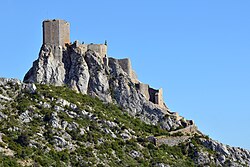
The Château de Quéribus is a ruined castle in the commune of Cucugnan in the Aude département of France. It has been listed as a monument historique by the French Ministry of Culture since 1907.
Queribus is one of the "Five Sons of Carcassonne", along with Aguilar, Peyrepertuse, Termes and Puilaurens: five castles strategically placed to defend the French border against the Spanish, until the border was moved in 1659.
It is sometimes regarded as the last Cathar stronghold. After the fall of Montségur in 1244, surviving Cathars gathered together in another mountain-top stronghold on the border of Aragon.
In 1255, a French army under the command of Olivier de Termes, a former Cathar knight, was dispatched to deal with these last remaining Cathars. Quéribus was defended by Chabert de Barbaira, who surrendered the castle without a fight in unclear circumstances. He may have been deceived by or have made a deal with his former friend Olivier de Termes. The fate of the Cathar occupiers of the castle is unknown, but they possibly slipped away, probably to Aragon or Piedmont - both regions where Cathar beliefs were still common, and where the Occitan language was spoken.
Quéribus is high and isolated. It stands on top of the highest peak for kilometres around. In 1951, restoration work on the turret began and, between 1998 and 2002, a complete restoration of the castle was undertaken. The castle is now accessible to visitors.
It is at coordinates 42°50′11″N 2°37′16″E and an altitude of 728 metres. The nearest village is Maury, Pyrénées-Orientales.
4.7 km
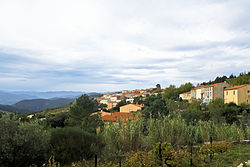
Lesquerde is a commune in the Pyrénées-Orientales department in southern France.

4.9 km
Cucugnan is a commune in the Aude department in southern France, approximately 29.5 kilometres north-west of Perpignan. The small village lies in a valley in the Corbières Massif, overlooked by the ruined Château de Quéribus, which stands at the top of a 728-metre hill to the south of Cucugnan.
C'est une halte ferroviaire du Train du pays Cathare et du Fenouillèdes, desservie par tous les trains touristiques de cette association.
Book your tour near
Gare de Maury
Book Now
4.4
in partnership with
GetYourGuide.com