

 English
 Français
Earth Centre, Doncaster
The Earth Centre, Doncaster was a large-scale visitor attraction which was established to provide both education and entertainment around environmental issues and sustainable practices. It was located on a 400-acre former colliery site in Conisbrough, Metropolitan borough of Doncaster, South Yorkshire, England, which was seen at the time as one of the most environmentally damaged areas in the country. Opened in 1999, it used funding from the Millennium Commission, the European Commission and English Partnerships. It closed its doors in 2004.
Nearby Places View Menu

265 m
Conisbrough railway station
Conisbrough railway station is a railway station in Conisbrough, South Yorkshire, England. It has two platforms and is served by stopping services.
Situated to the north-east of the station between the River Don and Conisbrough tunnel is a passing loop. This is used for freight to allow passenger services to pass. It has previously been used for commuter trains also allowing faster trains to pass. The branch has access to both Doncaster & Sheffield trains.
545 m
River Dearne
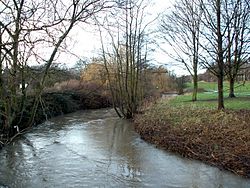
The River Dearne in South Yorkshire, England flows roughly east for more than 30 kilometres (19 mi), from its source just inside West Yorkshire. It flows through Denby Dale, Clayton West, Darton, Barnsley, Darfield, Wath upon Dearne, Bolton on Dearne, Adwick upon Dearne and Mexborough to its confluence with the River Don at Denaby Main. Its main tributary is the River Dove, which joins it at Darfield. The river was one of those affected by the 2007 United Kingdom floods.
The course of the river is accessible to walkers as the Dearne Way, a long distance footpath from Dearne Head to the river's junction with the Don. Places of interest along the Dearne include the Yorkshire Sculpture Park at West Bretton, and Monk Bretton Priory. The Dearne Valley below Barnsley is a regeneration area.
The river has been subject to channel engineering to ease the problem of flooding. A new channel was constructed near its mouth in the 1950s, as the old route had been affected by mining subsidence. Washlands, which can be progressively flooded as water levels rise, were constructed in the 1960s and 1970s. A flood relief channel and a regulator to restrict the flow was built at Bolton upon Dearne. During the 2007 United Kingdom floods, the washlands filled to capacity but the regulator could not be operated as it had been vandalised.
Industrialisation caused the river and the Dearne and Dove Canal, to become grossly polluted in the early nineteenth century and fish populations died. The West Riding River Board tried to address the problems in 1896 with limited success and much of the river remained dead until the 1980s, when industrial effluents were removed before they were discharged and improvements were made to sewage treatment. Despite setbacks, fish populations had been partially reinstated by the early 1990s. Channel engineering was carried out at Denaby in the 1990s, to re-introduce bends, deep pools and shallow gravel riffles, to assist fish spawning. In June 2015, salmon were reported in the river for the first time in 150 years.

557 m
Cadeby Main Colliery
The Cadeby Main Colliery was a coal mine sunk in 1889 in Cadeby, South Yorkshire, England. It commenced production in 1893 and was worked until it was exhausted in 1986.
557 m
Cadeby Main pit disaster
The Cadeby Main Pit Disaster was a coal mining accident on 9 July 1912 which occurred at Cadeby Main Colliery in Cadeby, West Riding of Yorkshire, England, killing 91 men. Early in the morning of 9 July an explosion in the south-west part of the Cadeby Main pit killed 35 men, with three more dying later due to their injuries. Later in the same day, after a rescue party was sent below ground, another explosion occurred, killing 53 men of the rescue party.