


St Mellanus church is a Grade I listed parish church in Mullion, on the Lizard Peninsula in Cornwall, England. The present building dates primarily from the 15th and early 16th centuries and includes a west tower, north and south aisles, and a south porch. The church is primarily known for its early 16th-century carved oak bench ends, combining Gothic and Renaissance decorative forms.
Gallery


Sponsored
Location

137 m
Mullion is a civil parish and village on the Lizard Peninsula in south Cornwall, England, United Kingdom. The nearest town is Helston approximately 5 miles to the north.
Mullion civil parish encompasses the church town and four smaller settlements: Mullion Cove and Predannack to the southwest; Trewoon and Meaver to the east. Mullion is bordered by the parishes of Gunwalloe and Cury to the north, Grade-Ruan to the east, Landewednack to the south, and by Mount's Bay to the west. The parish also includes Mullion Island, a uninhabited island approximately half a mile offshore from Mullion Cove. The island is home to large colonies of seabirds and is owned by the National Trust.
456 m
Mullion School is a coeducational secondary school located in Mullion, which is on the Lizard Peninsula in Cornwall, England, UK The year groups are seven to eleven. Mullion school was declared open by The Prince of Wales on 20 May 1980. The school's logo is the arctic tern, which has a migration pattern of 5 years as it goes from the North Pole to the South Pole: the same amount of time as it takes to go through secondary school.
Previously a foundation school and Performing Arts College administered by Cornwall Council, in June 2017 Mullion School converted to academy status. The school is now sponsored by Truro and Penwith Academy Trust.
803 m
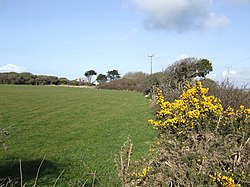
Meaver is a hamlet east of Mullion and in the parish of Mullion in west Cornwall, England.

840 m
Mullion Football Club is a football club based in Mullion, Cornwall. They are currently members of the St Piran League Premier Division West and play at Clifden Park.
1.5 km
Poldhu is a small area in south Cornwall, England, UK, situated on the Lizard Peninsula; it comprises Poldhu Point and Poldhu Cove. Poldhu means "black pool" in Cornish. Poldhu lies on the coast of Mount's Bay and is in the northern part of the parish of Mullion; the churchtown is 2 kilometres to the south-east. On the north side of Poldhu Cove is the parish of Gunwalloe and the village of Porthleven is a further 7 kilometres to the north.
Poldhu Point became the site of one of the main technological advances of the early twentieth century when, on 12 December 1901, a wireless signal was sent by Thomas Barron in Poldhu to St. John's, Newfoundland, and received by Guglielmo Marconi. The technology was a precursor to radio, television, satellites and the internet, with the earth station at Goonhilly Downs a nearby example.
The beach at Poldhu was heavily mined during World War II to prevent any prospect of a German force landing there. As a result, on 24 April 1943, Royal Air Force Volunteer Reserve members Mair Myfannwy Richards and Reginald Thomas Smith both died instantly when Mair trod on an unmarked mine.
In January 2016, Poldhu Cove was inundated with thousands of pink plastic bottles, brought onto the beach with successive tides. The National Trust, which organised the clean-up, thought they had likely come from a container ship, and had been washed overboard in recent storms.
Book your tour near
St Mellanus Church, Mullion
Book Now
4.1
in partnership with
GetYourGuide.com