



LUMA Arles est un complexe artistique et culturel réalisé par la Fondation LUMA de Maja Hoffmann sur le Parc des Ateliers à Arles en France. Le site englobe sept anciennes usines ferroviaires rénovées et une tour conçue par l’architecte Frank Gehry. L’ensemble du parc accueille des expositions, des performances, du spectacle vivant, des conférences, des présentations et résidences d’artistes.
Gallery

Sponsored
Location
1 explorer visited this place

82 m
The LUMA Tower is a building designed by Frank Gehry for the LUMA Arles arts center in Arles, France, commissioned by arts patron Maja Hoffmann, founder of the LUMA Foundation. It was inaugurated on July 4, 2021.

82 m
Luma Arles is an arts center in Arles, France created by the LUMA Foundation headed by Swiss arts patron Maja Hoffmann. It encompasses several renovated former railroad factories and the LUMA Tower, a 15,000 square meter tower building designed by the Canadian-American architect Frank Gehry for the LUMA Foundation. For the building Gehry took some of his inspiration from the Post-Impressionist painter Vincent van Gogh, hoping to catch the light the Dutch artist sought in the South of France, specifically as in Starry Night which was painted in Arles in 1889. The skin of the building features 11,000 angled reflective stainless steel panels.
The center was founded by Maja Hoffmann, who heads the foundation and collaborated with Gehry on the tower's genesis.
The building includes exhibition spaces, workshops, a library, an auditorium with 150 seats, and a café.
The magazine Artnet reported that the total cost of the project is understood to be 150 million euros, but Maja Hoffmann has refused to comment on the figure.

294 m
The Alyscamps is a large Roman necropolis, which is a short distance outside the walls of the old town of Arles, France. It was one of the most famous necropolises of the ancient world. The name comes from the Provençal Occitan word Aliscamps, which comes from the Latin Elisii Campi. They were famous in the Middle Ages and are referred to by Ariosto in Orlando Furioso and by Dante in the Inferno.
Roman cities traditionally forbade burials within the city limits. It was therefore common for the roads immediately outside a city to be lined with tombs and mausoleums; the Appian Way outside Rome provides a good example. The Alyscamps was Arles' main burial ground for nearly 1,500 years. It was the final segment of the Aurelian Way leading up to the city gates and was used as a burial ground for well-off citizens, whose memorials ranged from simple sarcophagi to elaborate monuments. In 1981, the Alyscamps was classified a UNESCO World Heritage Site, as part of the Arles, Roman and Romanesque Monuments group.

464 m
The Abbey of St Caesarius, at first called the abbey or monastery of St John, was a nunnery in the city of Arles in the south-eastern corner of the rampart. It was founded in 512 AD by Saint Caesarius of Arles, after whom it is now named. The abbey was suppressed in the French Revolution. Those that remained of the buildings were later used as a hospice; they are now abandoned.

607 m
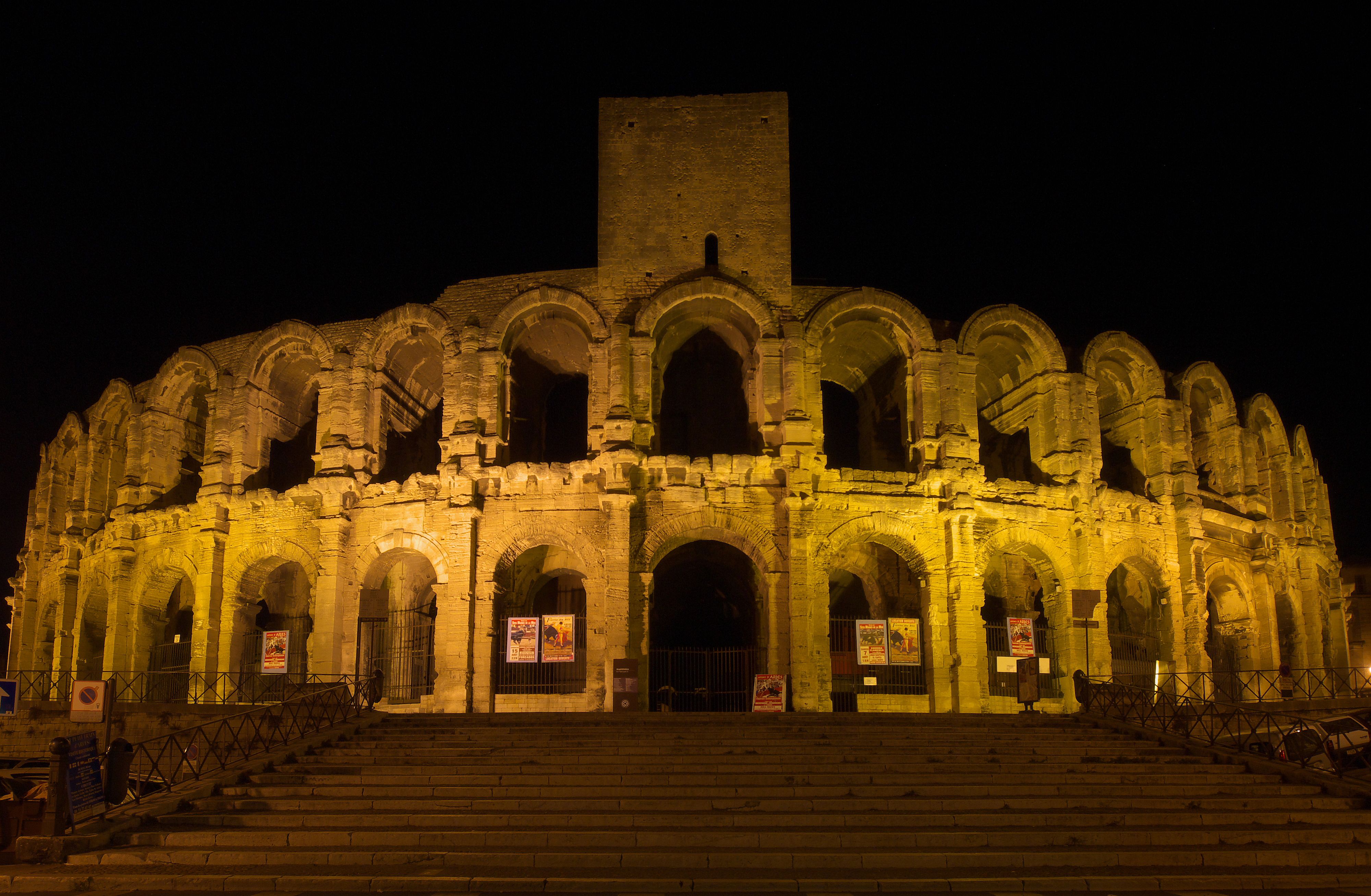
The Arles Amphitheatre is a Roman amphitheatre in Arles, southern France. Two-tiered, it is likely the most prominent tourist attraction in the city which thrived in ancient Rome. The towers jutting out from the top are medieval add-ons.
Built in 90 AD, the amphitheatre held over 20,000 spectators of chariot races and bloody hand-to-hand battles. Nowadays, it draws smaller crowds for bullfighting during the Feria d'Arles, as well as plays and concerts in summer.
In 1981, Arles Amphitheatre was listed as a UNESCO World Heritage Site, together with other Roman and medieval buildings of the city, as part of the Arles, Roman and Romanesque Monuments group.