

 English
 Français

Runswick Bay
Runswick Bay est un village du Yorkshire du Nord en Angleterre. Il est situé à l'ouest de la baie du même nom, à 8 km au nord de Whitby, près des villages d'Ellerby et Hinderwell.
Nearby Places View Menu

372 m
Runswick Lifeboat Station
Runswick RNLI Lifeboat Station was located in the village of Runswick Bay, approximately 7 mi (11 km) north-west of Whitby, in the county of North Yorkshire, England.
A lifeboat station was established here in 1866 by the Royal National Lifeboat Institution (RNLI).
In 1978, the nearby lifeboat station at Staithes was reopened as in Inshore lifeboat station, and renamed Staithes and Runswick Lifeboat Station. The Runswick All-weather lifeboat 37-11 The Royal Thames (ON 978) was withdrawn, and Runswick Lifeboat Station closed.
Following a meeting of the local population, and with the view that a rescue service was still required, the Independent Runswick Bay Rescue Boat was established in 1982.
373 m
Runswick Bay Rescue Boat
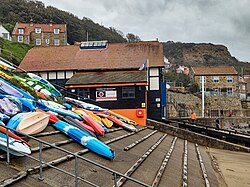
Runswick Bay Rescue Boat operates out of the former RNLI Tractor shed, and is located in the village of Runswick Bay, in the county of North Yorkshire, in England.
Runswick Lifeboat Station was opened here in 1866 by the Royal National Lifeboat Institution (RNLI). The station remained in operation until 1978, when the All-weather lifeboat was withdrawn, and the former station at nearby Staithes was reopened as an Inshore lifeboat station.
A rescue service was re-established in 1982 by the locally formed Runswick Bay Rescue Boat Association (RBRB).
RBRB currently operate a 4.8 m (16 ft) Ribcraft RIB, Spirit of Nagar, on station since 2020.

440 m
Hob Holes
The Hob Holes are caves in the cliffs of Runswick Bay, Scarborough, England which resulted from mining for jet – fossilised wood which is valuable as a gemstone.
A hobgoblin, a bogle, or a hob was rumored to live there. Local mothers would visit the site with their children during low tide, seeking a remedy for whooping cough by calling on the spirit with the words:
Hob Hole hob, my child has the kin cough,
Take it off, Take it off!
One account mentions that, apart from aiding with childhood illnesses, the hob would roam the moors behind the bay with a lantern, luring travelers into the rocky pits. On stormy nights, he would offer shelter in his hole, only to abandon them to the rising tide.
737 m
Runswick Bay
Runswick Bay is a bay in North Yorkshire, England. It is also the name of a village located on the western edge of the bay (although the village is sometimes shortened to Runswick on UK road signs). It is 5 miles (8 km) north of Whitby, and close to the villages of Ellerby and Hinderwell. Located within the North York Moors National Park, it is a popular tourist attraction, due to its picturesque cliffside village, stunning coastal walks, fossil hunting and Runswick Sands, a white sand beach. It is on the Cleveland Way national trail. Runswick Bay was chosen as Beach of the Year 2020 by The Sunday Times.
1.6 km
Silkstone Hall
Silkstone Hall is a historic building in Hinderwell, a village in North Yorkshire, in England.
The house was constructed for the artist Henry Silkstone Hopwood, to a design by Edgar Wood. It was completed in 1902, and was originally named "The Croft". After Hopwood's death in 1914, the building was occupied by the local Inspector of Mines. The building's architect was long forgotten, but was identified by the Edgar Wood Research Project in the 2010s, and as a result the house was grade II listed in 2015. Historic England describe it as an "exemplary example of Arts and Crafts architecture using local materials and vernacular forms".
The house was designed by Edgar Wood in Arts and Crafts style. It is in sandstone with pantile roofs, stone coped gables and kneelers. There are three storeys including attics, and a compact plan, and all the fronts are asymmetric. Most of the windows are mullioned, and here are bay windows. At the entrance to the drive is a gateway, and at the northwest is a pedestrian entrance, both with wrought iron gates in Art Nouveau style. The gate piers have wrought iron finials. Inside, there is an entrance hall leading to a central staircase. The northern first floor bedroom is believed to have originally been an artist's studio, and retains a fireplace which is likely to be original.