


La Porta Westfalica est une gorge située en Allemagne, formée par la Weser entre la Wiehengebirge à l'ouest et la Wesergebirge à l'est. Elle est située dans l'arrondissement de Minden-Lübbecke, en Rhénanie-du-Nord-Westphalie.
Gallery


Sponsored
Location

0 m
The Porta Westfalica, also known as the Westphalian Gap, is a gorge and water gap where the Weser river breaks through the passage between the mountain chains of the Wiehen Hills in the west and the Weser Hills in the east. It is located in the district of Minden-Lübbecke in North Rhine-Westphalia, Germany.
Since 1973, Porta Westfalica is also the name of a town, established by merging fifteen villages surrounding the gorge. Since 2006, it is a national geotope.
The name "Porta Westfalica" is a Latin term that means "Gate to Westphalia". Coming from the north, the gorge is the entry to the region of Westphalia. Despite its Latin name, the term was not coined in Roman Empire times, but by scholars in the 19th century.
High above the gorge on the west side is a large six-sided stone structure that can be seen from a considerable distance; this is the Emperor William Monument, erected in honour of Emperor William I of Germany and dedicated in 1896.

123 m
Porta Westfalica is a railway station located in Porta Westfalica, Germany. The original station was opened in 1847 and the current station was completed in 1916. It is located on the Hamm–Minden railway. The train services are operated by Deutsche Bahn and WestfalenBahn.

693 m
The Weser-Leine-Express is the name used in North Rhine-Westphalia for a Regional-Express service that connects the east Westphalian regional centre of Bielefeld and Minden and the Lower Saxony regional centres of Hanover and Braunschweig. The NRW government found that there was sufficient state interest for it to support operations on the section in that state. The service alternates with the Ems-Leine-Express, which connects Rheine with Minden and Braunschweig. The border between North Rhine-Westphalia and Lower Saxony Between is crossed between Minden and Bückeburg.
966 m
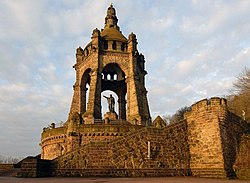
The Emperor William Monument, near the town of Porta Westfalica in the North Rhine-Westphalian county of Minden-Lübbecke, is a colossal monument above the Weser gorge of Porta Westfalica, the "Gateway to Westphalia". It was erected to honour the first German Emperor, William I, by the then Prussian Province of Westphalia between 1892 and 1896 and emerged against the background of a rising German national identity. The monument, which is around 88 metres high, is classified as one of Germany's national monuments.
The architect of this prominent monument was Bruno Schmitz and the sculptor was Kaspar von Zumbusch. Since 2008, the monument has formed part of the Road of Monuments. As a result of its dominant geographical site, it is the most important landmark of the town of Porta Westfalica and of northern East Westphalia.

1.1 km
Jakobsberg Telecommunication Tower is a 142-metre-tall TV tower built of reinforced concrete on the 238-metre-high elevated Jakobsberg near Porta Westfalica. Jakobsberg Telecommunication Tower was built May 1, 1974 and September 28, 1978 as replacement for a small telecommunication tower also equipped with an observation deck, which was built in 1952 on the site
of the former Bismarck column, erected in 1902.
Jakobsberg Telecommunication Tower is equipped with a room for technical equipment in a height of 50 metres and an observation deck in a height of 23.25 metres. Its main purpose is the transmission of television and radio signals, since 2006 the television signals are sent in DVB-T.
For access to the observation deck, there is a stairway running like a srewline around the tower. This stairway gives the lowest sections of Jakobsberg Telecommunication Tower, which is property of Deutsche Telekom, its characteristic design.