


Les jardins botaniques royaux, situés à Burlington et Hamilton en Ontario au Canada, constituent une des attractions touristiques majeures située à mi-chemin entre les chutes du Niagara et Toronto. Le parc est implanté sur 980 hectares en bordure du Lac Ontario, il a été reconnu lieu patrimonial du Canada en 1993 et il est considéré depuis 2006 comme un parc de référence pour la biodiversité.
Gallery

Sponsored
Location
2 explorers visited this place
0 m
The Royal Botanical Gardens is a heritage-listed botanical garden located in the cities of Burlington and Hamilton in Ontario, Canada. It covers extensive environmentally protected areas, historic sites, and culturally relevant gardens from Burlington to Hamilton. It is one of the major tourist attractions between Niagara Falls and Toronto, as well as being a significant local and regional horticultural, education, conservation, and scientific resource.
The Royal Botanical Gardens' mandate derives from a Provincial Act of 1941, centred on human interaction with the natural world and protection of environmentally significant lands that form the western tip of Lake Ontario. The gardens cover an area of approximately 10 km by 4 km that is dominated by two coastal wetlands, and landscapes that were carved during the last glaciation, extending from Lake Ontario inland to the plateau of the Niagara Escarpment. The many different gardens and natural areas are accessed through nine public entrance locations. The Royal Botanical Gardens is one of several Prescribed Public Bodies listed under the Ontario Heritage Act.
In 2006, in support of the United Nations Convention on Biological Diversity, Royal Botanical Gardens was selected as Canada's National Focal Point for the Global Strategy for Plant Conservation by Environment and Climate Change Canada.
The 980 hectares of nature sanctuary owned by the Royal Botanical Gardens is largely a remnant of the Dundas Marsh Game Preserve created in 1927. The properties now carry many cultural and environmental designations. Multiple national historic site features are associated with area, with the site featuring prominently as a landing and connection point to other regions of the Great Lakes. It is considered an important plant biodiversity hotspot for Canada, with a very high proportion of the wild plants of Canada in one area; is an Important Bird Area according to Bird Studies Canada; and is part of the Niagara Escarpment World Biosphere Reserve. More than 1,100 species of plants grow within its boundaries including the Bashful Bulrush which is found nowhere else in Canada, and the largest remaining population of one of Canada's most endangered trees, the Red Mulberry. Both of these plants are listed as Endangered in Canada under the Species at Risk Act. In 2008, the RBG was designated as an Important Amphibian and Reptile Area by CARCNET, the Canadian Amphibian and Reptile Conservation Network. Several plants listed on various Endangered Species Protection programs are held for protection and education purposes in various garden areas.
Unusually, Royal Botanical Gardens is both the owner of the land under the provincially significant Class 1 Wetland, Cootes Paradise, and Grindstone Marsh as well as regulator of activities on the water, despite it being an inlet of Lake Ontario. Water area activity regulation was formerly under the Hamilton Harbour Commission as part of the areas historical federal port regulation. In the late 1970s the Harbour Commission and Royal Botanical Gardens made an agreement transferring regulation of use of the water area to the Gardens in support of its environmental protection mandate. However, Royal Botanical Gardens has no regulatory control over the quality of water flowing into its wetlands.

592 m
Grindstone Creek is a stream in the Greater Toronto and Hamilton Area, Ontario, Canada. It is in the Great Lakes Basin and is a tributary of Lake Ontario at the western end of the lake.
The creek begins Lake Medad in the city of Burlington, Regional Municipality of Halton. It flows west immediately into the unitary city of Hamilton. The creek turns southwest into the community of Waterdown, and flows over the Niagara Escarpment at Boundary Falls. It re-enters Burlington at the community of Aldershot, turns west, and reaches its mouth at Hamilton Harbour on Lake Ontario, adjacent to the Royal Botanical Gardens.

1.3 km
Bayview Junction is a major railway junction in southern Ontario, Canada. It is located at the intersection of three of the nation's busiest rail lines and is a popular location for railfans and trainspotters.
Located at the western end of Lake Ontario, this wye junction draws its name from the view of Burlington Bay to the east. Bayview Junction is located in the city of Hamilton, immediately adjacent to its boundary with the city of Burlington. The railway lines bisect the property of the Royal Botanical Gardens, providing a picturesque setting.

1.8 km
The Desjardins Canal disaster was a rail transport disaster near Hamilton, Canada West. The train wreck occurred at 6:15 p.m. on March 12, 1857 when a train on the Great Western Railway crashed through a bridge over the Desjardins Canal, causing the train and its passengers to fall 18 metres into the ice below. With 59 deaths, it is considered one of the worst rail disasters in Canadian history.
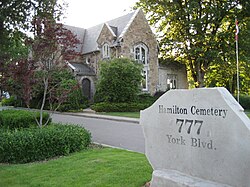
2.0 km
Hamilton Cemetery on York Boulevard in Hamilton, Ontario, is the oldest public burial ground in the city. It is located on Burlington Heights, a high sand and gravel isthmus that separates Hamilton's harbor on the east from Cootes Paradise on the west.
Book your tour near
Jardins botaniques royaux
→
Voir aussi
Liste des lieux patrimoniaux de la municipalité régionale de Halton
Notes et références
(en) Cet article est partiellement ou en totalité issu de l’article de Wikipédia en anglais intitulé « Royal Botanical Gardens (Ontario) » (voir la liste des auteurs).