


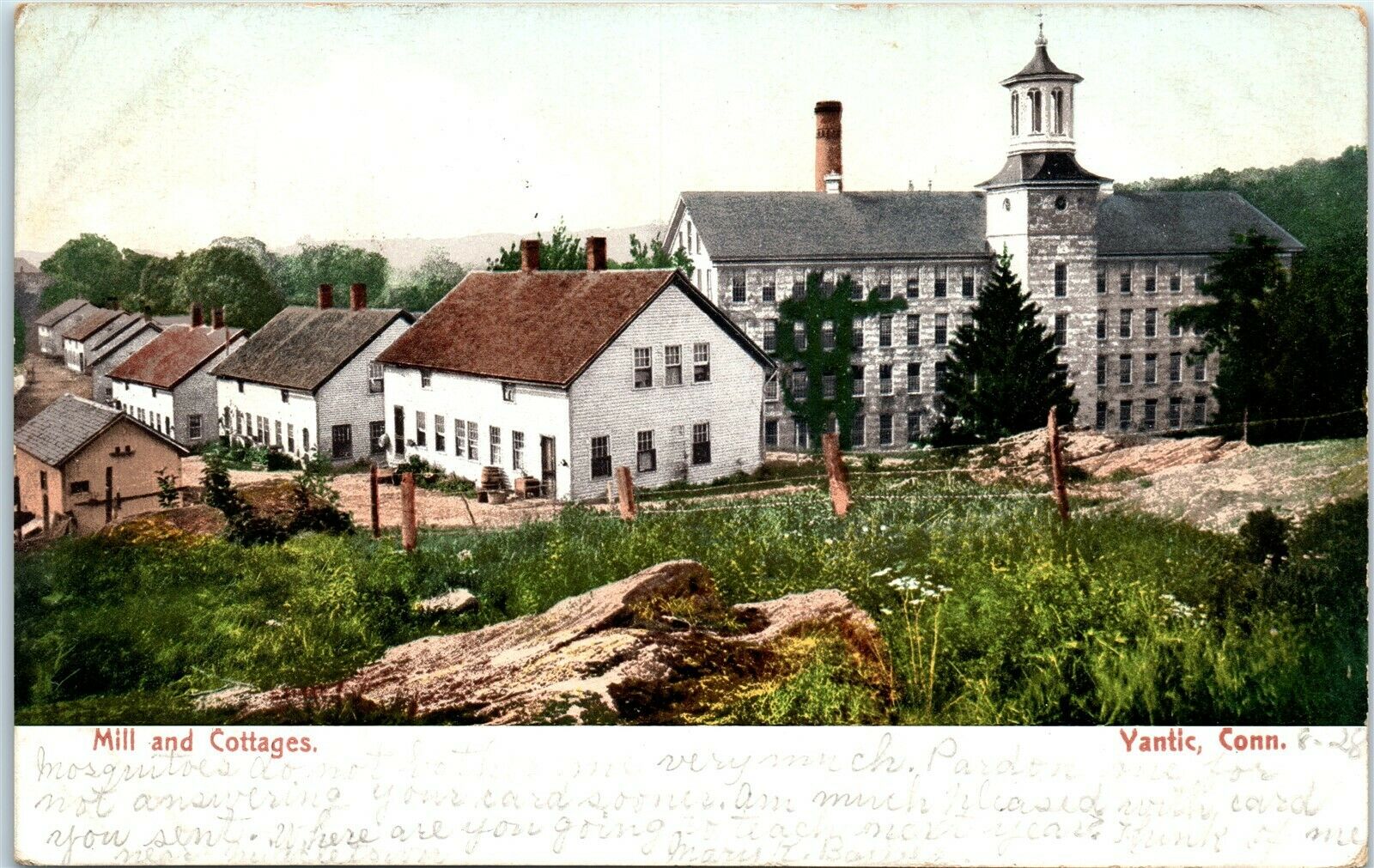
The Yantic Woolen Company Mill, also known as the Hale Company Mill, is a mill complex located at the junction of Chapel Hill and Yantic Roads in northwestern Norwich, Connecticut. Built in 1865, the stone mill is a well-preserved example of mid-19th century textile mill architecture, and was the major economic force in the village of Yantic, where it stands.
Gallery

Sponsored
Location
1 explorer visited this place

1.3 km
The Bean Hill Historic District is in Norwich, Connecticut, listed on the National Register of Historic Places in 1982. It consists of a well-preserved collection of buildings on the Bean Hill Green which capture the 19th-century period when Bean Hill was a center for manufacturing and commercial activity. The district is located in the vicinity of West Town Street between I-395 and Connecticut Avenue, and it also extends northeast along Huntington Avenue to include properties beyond Bean Hill Plain. The district is about 22 acres in size, with 23 contributing buildings.
The Bean Hill Green is a square parcel of open space bounded by Vegason Avenue, Huntington Avenue, and West Town Street. It was laid out in 1729, forming the centerpiece of a residential nucleus. The buildings facing the green include four houses from the 18th century, as well as the former 1833 Bean Hill Methodist Church, the first Methodist church in Norwich.

2.1 km
Senator Thomas J. Dodd Memorial Stadium is a stadium in Norwich, Connecticut. It is primarily used for baseball, and since 2010, has been the home of the Norwich Sea Unicorns, who were previously known as the Connecticut Tigers. It was the home field of the Connecticut Defenders minor league baseball team until 2009 when the Defenders announced their move to Richmond, Virginia, to become known as the Richmond Flying Squirrels. It was built in 1995 and has a seating capacity of 6,270. It is named for Eastern Connecticut native Thomas Dodd who was a United States senator and Representative from Connecticut, and the father of U.S. Senator Christopher Dodd.

2.6 km
The Dr. Philip Turner House is a historic house at 29 West Town Street in Norwich, Connecticut, possibly built in the late 17th century. It is one of the oldest houses in Norwich, and a well-preserved example of vernacular architecture. It was probably owned by Dr. Philip Turner at the time of the American Revolutionary War, who was a leading surgeon for the Continental Army. It was listed on the National Register of Historic Places on October 15, 1970.
2.7 km
Norwich Public Schools is the public school system for the town of Norwich, Connecticut. NPS serves approximately 3,600 students every year through 10 school locations within the City of Norwich. running a 9–12 transition academy, a regional adult education program, a child care center, seven elementary schools, two magnet middle schools, and a child care center. 8th-grade graduates are able to various local high school programs, such as Norwich Free Academy, Norwich Technical High School, Ledyard Agri-Science Program, LEARN Regional Magnet Schools, Bacon Academy, Ella T. Grasso Southeastern Technical High School, and other local programs. Norwich Public Schools employs more than 1,000 staff, including teachers and administrators. Norwich Public Schools has been serving the City of Norwich for nearly 150 years, with the opening of its first school in 1875. The John Mason School building, built in 1895, is currently in use as the school system's district office.

2.7 km
The Carpenter House, also known as the Gardiner Carpenter House and the Red House, is a Georgian style house in Norwichtown area of Norwich, Connecticut. A house was previously on the site, but it was removed by Gardner Carpenter to construct the house in 1793. The three-story Flemish bond Georgian house's front facade consists of five bays with a gabled porch over the main entrance and supported by round columns. The gambrel roof and third story addition were added around 1816 by Joseph Huntington. In 1958, a modern one-story rear wing was added to the back of the house. The interior of the house is a center hall plan with 10-foot high ceilings and has been renovated, but retains much of its original molding, paneling and wrought iron hardware. It was listed on the National Register of Historic Places in 1970 and added to the Norwichtown Historic District in 1973.
The mill was listed on the National Register of Historic Places on July 25, 1996.