

 English
 Français

Kirkcaldy Sheriff Court
Kirkcaldy Sheriff Court, formerly known as County Buildings, is a judicial building on Whytescauseway in Kirkcaldy in Scotland. The building, which continues to operate a courthouse, is a Category B listed building.
Nearby Places View Menu

85 m
Kirkcaldy Town House
Kirkcaldy Town House is a Scandinavian influenced town hall located in Kirkcaldy, Fife, Scotland. The current town house was begun in 1937, from a competition-winning design by architects David Carr and William Howard of Edinburgh. Only the foundations had been put in place before construction was interrupted by the Second World War. Work resumed on the building in 1950 and was completed in two separate phases between 1953 and 1956. The town house would serve as the headquarters of Kirkcaldy Town Council from 1956 to 1975 and then Kirkcaldy District Council from 1975 to 1996. Today, the role of the town house is the headquarters of the local area committee of Fife Council. Kirkcaldy Town House is protected as a Category B listed building.

300 m
Fife Opera
Fife Opera is a semi-professional grand opera company dating back to 1976, and based in Kirkcaldy, Scotland. It has produced over 40 full-scale productions since its inception.
At present, it is one of only a handful of companies left in Scotland today producing large-scale operas, and one of the few to routinely to play with a full orchestra, and the foremost company of its sort in Fife.

309 m
Kirkcaldy
Kirkcaldy ( kur-KAW-dee; Scots: Kirkcaldy; Scottish Gaelic: Cair Chaladain) is a town and former royal burgh in Fife, on the east coast of Scotland. It is about 11+1⁄2 miles (19 kilometres) north of Edinburgh and 27+1⁄2 mi (44 km) south-southwest of Dundee. The town had a recorded population of 49,460 in 2011, making it Fife's second-largest settlement and the 11th most populous settlement in Scotland.
Kirkcaldy has long been nicknamed the Lang Toun (; Scots for "long town") in reference to the early town's 0.9-mile (1.4 km) main street, as indicated on maps from the 16th and 17th centuries. The street would finally reach a length of nearly four miles (six kilometres), connecting the burgh to the neighbouring settlements of Linktown, Pathhead, Sinclairtown and Gallatown, which became part of the town in 1876. The formerly separate burgh of Dysart was also later absorbed into Kirkcaldy in 1930 under an act of Parliament.
The area around Kirkcaldy has been inhabited since the Bronze Age. The first document to refer to the town is from 1075, when Malcolm III granted the settlement to the church of Dunfermline. David I later gave the burgh to Dunfermline Abbey, which had succeeded the church: a status which was officially recognised by Robert I in 1327. The town only gained its independence from Abbey rule when it was created a royal burgh by Charles I in 1644.
From the early 16th century, the establishment of a harbour at the East Burn confirmed the town's early role as an important trading port. The town also began to develop around the salt, coal mining and nail making industries. The production of linen which followed in 1672 was later instrumental in the introduction of floorcloth in 1847 by linen manufacturer, Michael Nairn. In 1877 this in turn contributed to linoleum, which became the town's most successful industry: Kirkcaldy was a world producer until well into the mid-1960s. The town expanded considerably in the 1950s and 1960s, though the decline of the linoleum industry and other manufacturing restricted its growth thereafter.
Today, the town is a major service centre for the central Fife area. Public facilities include a main leisure centre, theatre, museum and art gallery, three public parks and an ice rink. Kirkcaldy is also known as the birthplace of social philosopher and economist Adam Smith who wrote his magnum opus The Wealth of Nations in the town. In the early 21st century, employment is dominated by the service sector: the biggest employer in the town is PayWizard, formerly known as MGT plc (call centre). Other main employers include NHS Fife, Forbo (linoleum and vinyl floor coverings), Fife College, Whitworths (flour millers) and Smith Anderson (paper making).
326 m
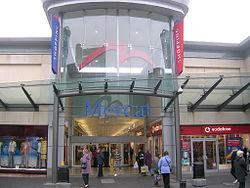
The Mercat Shopping Centre
The Mercat Shopping Centre ( MERR-kət) is located in Kirkcaldy, Fife, Scotland, United Kingdom. The Mercat – including surrounding areas – accounts for at least 30% of all the floorspace in Kirkcaldy town centre, which in total is 46,000-square-metre (500,000 sq ft) and providing as much as 200 shops, making Kirkcaldy the largest shopping area in Fife.
The shopping centre was built in two phases between 1972 and 1981–83 with a refurbishment completed in 1997. A proposal to extend the shopping centre for a third phase is pending.
In 1996 plans to broadcast an episode of Family Fortunes live from the Mercat Centre were scrapped due to concerns that the event would not be covered by the Centre's insurance company. Les Dennis described the decision as "unfortunate, but sadly unavoidable".
The shopping centre is currently owned by Mars Pension Fund and managed by Lasalle Investment Management.