


Trimlini (pronounced [tɾiˈmliːni]; Hungarian: Hármasmalom) is a settlement south of Lendava in the Prekmurje region of Slovenia.
Book your tour near
Trimlini
Book Now
4.2
in partnership with
GetYourGuide.com
Location
1.5 km
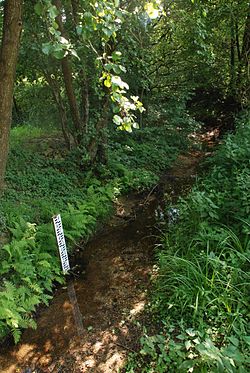
Črnec Creek is a stream of Slovenia. It is a left tributary of the Ledava near Čentiba.
It has its source south of Murska Sobota and flows southeastward. It is joined by Dobel Creek between Beltinci and Odranci, flows past the village of Odranci, and is then joined by Black Creek north of Kapca. After passing southwest of Lendava, it flows parallel to the Ledava River before emptying into the Ledava southwest of Čentiba. The stream is about 26 kilometers long.
The name Črnec means 'the black one'. The creek was attested in historical documents in 1244 as Cernech, and in Hungarian in the 20th century as Csernec patak. Like similar names of streams, the semantic motivation for the name is a creek that flows through a dark soil bed or that carries dark, turbid water.
1.6 km
Kobilje Creek is a stream in northeastern Slovenia and western Hungary. The stream is 33 kilometres long; 24 km of the course is in Slovenia. Its source is at Kamenek Hill and it flows through Kobilje, crosses the Slovenian–Hungarian border, returns to Slovenia, and joins the Ledava from its left side in the town Lendava. It is the longest tributary of the Ledava.
1.8 km
Dolnji Lakoš is a village southwest of Lendava in the Prekmurje region of Slovenia.
1.9 km
Lendava Sports Park is a multi-use stadium in Lendava, Slovenia. It is currently used mostly for football matches and is the home ground of NK Nafta 1903. The stadium, initially built in 1946, was completely rebuilt in 2006 and has a capacity of 2,000 seats.
The stadium has a UEFA licence for international matches and is used as one of the venues for Slovenia's youth national teams.

2.2 km
The Lendava Synagogue is a former Orthodox Jewish congregation and synagogue, located in the small town of Lendava, Slovenia, a town that is close to the Hungarian border. The former congregation was established in 1773 and worshiped in the Ashkenazi rite. The former synagogue was completed in 1866 and was used as a synagogue up until 1944, when the community perished in The Holocaust.
Left vacant for many years, the former synagogue was repurposed as a Jewish museum, called the Galerija-Muzej Lendava, in the mid-1990s. The museum has a permanent exhibition on local Jewish history.