

 English
 Français
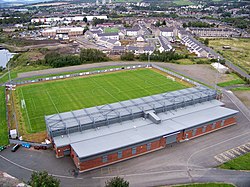
Dumbarton Football Stadium
The Dumbarton Football Stadium, known as the Marbill Coaches Stadium and commonly known as The Rock, is a stadium in Dumbarton, Scotland, used mostly for football matches; it is the home ground of Dumbarton Football Club. The stadium has a capacity of 2,020, and was built in 2000 after the move away from Dumbarton's former home, Boghead Park. It was built on part of the site formerly occupied by Denny's shipyard. The stadium is 5–10 minutes walk from Dumbarton East railway station on the North Clyde Line. Dumbarton have the third smallest stadium in the SPFL.
Nearby Places View Menu
131 m
Battle of Alclud Ford
The Battle of Alclud Ford took place between the post-Roman Celtic Britons of Rheged and the Anglo-Saxon Kingdom of Bernicia around c. 580CE. The fighting may have taken place at an unknown ford near Alt Clut, the original name for Dumbarton Rock, which may also be used for the entire ancient Kingdom of Strathclyde. The battle is recorded in two poems in the Book of Taliesin.

208 m
River Leven, Dunbartonshire
The River Leven (Scottish Gaelic: Uisge Leamhna) is a stretch of water in West Dunbartonshire, Scotland, flowing from Loch Lomond in the north to the River Clyde in the south. The river is about 6 miles (10 km) long. It is very popular with salmon and sea trout anglers, trying to catch one of these migratory fish going up to Loch Lomond.
The Vale of Leven is a collection of communities in the northern part of the river, whilst the town of Dumbarton sits at the southern end. Dumbarton Castle sits at the confluence of the river with the Clyde. The Leven is a relatively short river but is widely claimed to be the second fastest flowing river in Scotland, after the River Spey. Possibly because of this, or possibly because it passes through a built-up area, it has a reputation as a dangerous river with many drownings over the years. The Linnbrane Hole in Alexandria is reputed to be the most dangerous spot.
The river is crossed by nine bridges and two weirs. There is a path for pedestrians and cyclists near the river, which connects with a cycle path to Glasgow. It follows the river very closely from Balloch to Renton, less closely from Renton to Dumbarton. The river includes two large meander bends, at Cordale and Dalquhurn.
In the past the river was used to get steamers into Loch Lomond, although they sometimes did not find it an easy journey and could have difficulty getting past the bridges. Nowadays the river is considered to be not navigable. The height of the river can vary, sometimes being a good deal higher in winter than summer.

258 m
Rhapsody (climb)
Rhapsody is a 35-metre (115 ft) long traditional climbing route up a thin crack on a slightly overhanging vertical basalt rock face on Dumbarton Rock, in Scotland. When Scottish climber Dave MacLeod made the first free ascent in 2006, it became Britain's first-ever E11-graded route, and at the grade of 5.14c (8c+), Rhapsody was the world's hardest traditional route. It set a grade milestone in traditional climbing that stood for over a decade until the ascent of Tribe at grade E11-12 5.14d (9a) in 2019 and of Bon Voyage at grade E12 5.14d (9a) in 2024.
Rhapsody shares the same central crack-line as another notable traditional climbing route called Requiem (the two routes deviate for the last 10 metres near the top as the crack-line peters out). Scottish climber Dave Cuthbertson made the first free ascent of Requiem in 1983, creating Britain's first-ever E8-graded route. With subsequent ascents, the consensus grade settled at E8 6b or 5.13b (8a), and Requiem is now recognized as being one of the world's hardest rock climbing routes—of any format (i.e. traditional or sport climbing)—at the time it was first ascended in 1983.

274 m
Dumbarton Castle
Dumbarton Castle (Scottish Gaelic: Dùn Breatainn, pronounced [t̪unˈpɾʲɛʰt̪ɪɲ]; Welsh: Alt Clut) has the longest recorded history of any stronghold in Scotland. It sits on a volcanic plug of basalt known as Dumbarton Rock which is 240 feet (73 m) high and overlooks the Scottish town of Dumbarton.